

What Is a Death Doula?
This is part six of our 12-week series on natural burial. New here? Start with Intro to Green Burial, or read last week's comparison post.

A small group of mourners, embracing one another.
Most of us have heard of birth doulas and what they do, but it's less common to have heard about death doulas and their role in end-of-life arrangements. Birth doulas support a family through the preparation and arrival of a new life, whereas a death doula provides support at the end of life. For families considering a natural burial, end-of-life doulas are often what makes it possible.
What a Death Doula Does and Doesn't Do
A death doula provides non-medical support, guidance, and companionship to a dying person and their family. The work is grounded in presence more than procedure. Where a hospice nurse manages symptoms and medication, a death doula tends to the emotional weight and the planning, along with the simple, increasingly rare act of sitting with someone so they are not alone during what could be one of the hardest times in their lives.
The shape of a doula's work varies from family to family, but it often includes helping a person think through and write down their wishes, holding space for hard conversations, explaining what to expect as death approaches so it's less frightening, coordinating with hospice or palliative teams if needed, and supporting the family in the hours and days after death.
A death doula's work is grounded in presence more than procedure.
Essentially, a doula can meet a family wherever they are in their end-of-life planning. Some want deep involvement over many months while others want just a few hours of guidance at a single hard moment. Both are ways that death doulas can support a family while they're making end-of-life plans.
It's helpful to know the limits of the role, too. A death doula is not a medical provider, and they do not prescribe or administer medication or offer clinical care. They work alongside hospice and palliative teams rather than replacing them. They are not funeral directors either, though they often help a family understand and prepare for what comes next.
How Death Doulas Support a Green or Natural Burial
An end-of-life or death doula and natural burials tend to go hand in hand, and the reason is simple: both come from the same principles. Both ask families to step closer to death rather than hand it off to professional strangers, and both treat dying as a human passage rather than only a medical or commercial one. The doula is often the person who first tells a family that family-led, natural after-death care is even an option.

A quiet bench overlooking a meadow, the kind of place that could hold a natural burial ground.
In practical terms, a doula or end-of-care provider can guide a family through the parts of a green burial that feel unfamiliar but the family wishes to engage in. These may include how to keep a body cool at home for a few days, how to wash and dress the deceased with care, how to arrange transport, or how to work with a cemetery or funeral home that supports natural burial. For a family, having support in washing, or simply wrapping their loved one in a shroud and carrying them to the grave, can make all the difference between fear and confidence.
Calgary death doula Sarah Kerr offered a vivid example of this when she spoke with CBC about the death of her own father, Bill. After he died, Sarah and her family stayed with him at home for three days. They bathed him, built his casket, and told stories about him with his body still in the room. Sarah described the experience not as morbid but as a beautiful, slow, hands-on goodbye.
We see this desire for a more personal goodbye in our own work of creating natural woven burial shrouds. Individuals and families who choose our shrouds want a different kind of end-of-life return. They may want to give themselves the gift of time, to slow down the after-death care in order to grieve, reflect upon, and respect the person who died. It may be the environmental benefits of returning our body's nutrients and the shroud's natural fibres to the soil and then planting and nourishing native trees and wildflowers at the burial ground.
We're re-introducing the importance of our hands and our hearts to after-death care.
With natural burials becoming more common again, we're re-introducing the importance of our hands and our hearts to after-death care, a farewell that has become too clinical and lacks personal touch. A death doula can offer helpful hands when your hands may be shaky or uncertain, whether it be help with washing, wrapping, hugging, or carrying your loved one.
In a lovely parallel way, our woven shrouds are never the work of a single pair of hands either. Lesley weaves the cloth, and then it's cut and sewn into the finished shroud by Kate Delmage, a Nova Scotia apparel designer and seamstress, who has developed this collection alongside Lesley for over four years. Two people, two crafts, meeting in the same quiet, unhurried work. A death doula's hands move the same way, alongside a family's, never instead of them.
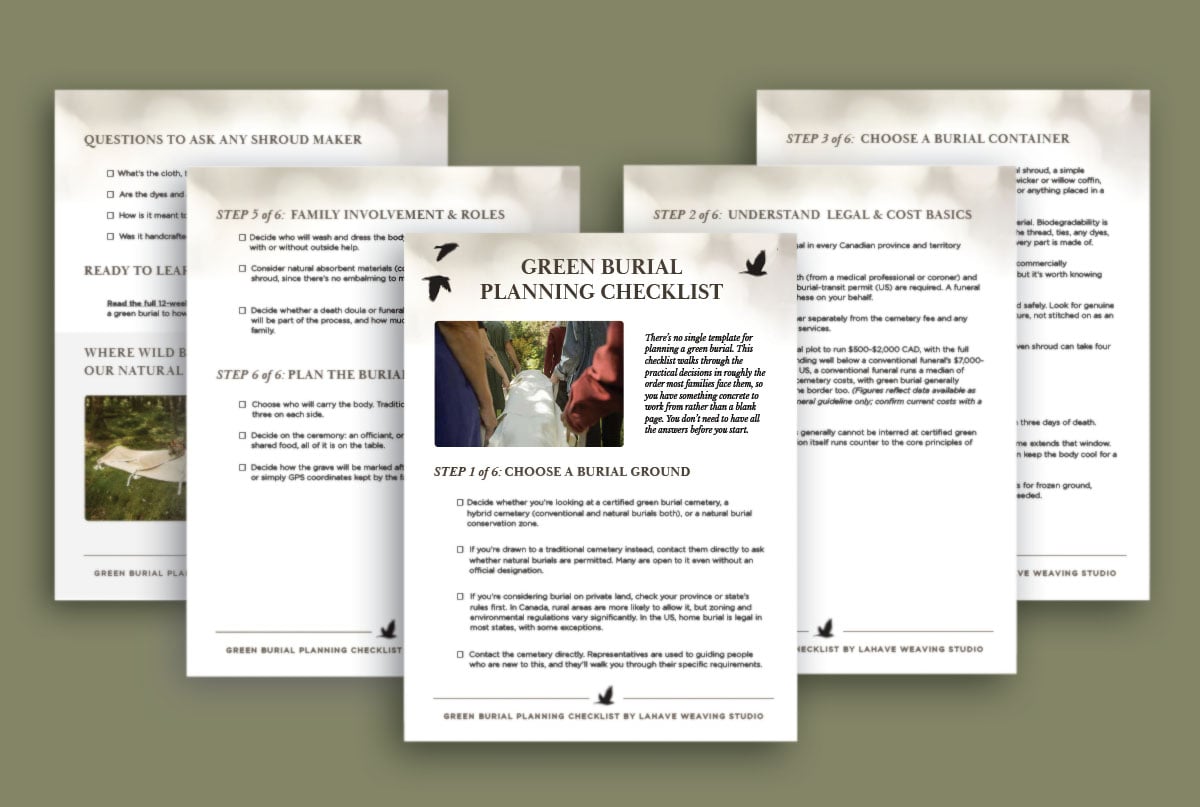
Download Your Free Copy of A Green Burial Planning Checklist
When and Why Families Choose to Work with a Doula
The modern profession of a death doula is surprisingly new. Sitting with the dying, though, is an ancient practice, a communal, sacred duty for most of human history. It traces back to a single volunteer program in New York that began with just five people paired with dying patients. The word itself carries a similar surprise: doula comes from an ancient Greek term for a woman servant, even a slave, the person who once did the most intimate and least wanted labour. Today, that same labour is something most of us hand over entirely to a funeral industry we've never had to think much about, until we suddenly do.

Two mourners, holding each other's hands, offering comfort.
So when and why do families decide to work with an end-of-life doula? A terminal diagnosis can make the road ahead feel suddenly frightening and lonely. The wish to die at home asks more of a family than most expect, and an end-of-life support person can assist. Sometimes a death simply arrives faster than anyone is ready for, and the family needs some help. Also, increasingly more people are interested in planning their end-of-life care and disposition years in advance, which often helps with family conversations.
The reasons that families give, after they've worked with a death doula, are remarkably consistent. They felt less alone, they were not rushed, and they understood what was happening. The greatest gift in working with a doula is arguably that families are able to be present for someone they loved, instead of managing logistics. For families drawn to natural burial because it is a personal and unhurried process, a doula is often what protects that experience.
A note on cost: most death doula services are not covered by insurance in either Canada or the US, and fees vary widely by region and by the depth of support you require. Many doulas offer a free initial consultation, and some offer sliding-scale rates, so it is always worth asking.
How to Find a Death Doula in Canada or the US
In both Canada and the US, the title death or end-of-life doula is not government-licensed; this is a self-regulating profession with no central accreditation body. That is no cause for worry, but it is the reason it makes sense to ask good questions. Whether you are looking for a death doula in Canada or the US, the most reliable path is through trusted local providers in your area, along with the established alliances and directories below, where members agree to a shared scope of practice and code of ethics.
Here in Nova Scotia, families have a few knowledgeable people close to home. Dawn Carson and Deborah Luscomb at Death Matters provide after-death care guidance and can walk a family through what is allowed and what is possible in this province, and Louisa Horne at Epilog offers similar support. These are the same trusted names we point to in our green burial FAQ, and they are a natural first call for anyone in the region. Families in British Columbia can also look to the Death Doula Network of BC, and in Ontario, the Death Doula Ontario Network connects doulas working across the province.
Beyond your own region, a few directories are reliable starting points:
- In Canada, the End of Life Doula Association of Canada maintains a referral service and a member directory organized by region. Its registered members train through a recognized program, carry a current criminal record check, and agree to the association's code of ethics.
- Across both countries, the National End-of-Life Doula Alliance (NEDA) offers a directory searchable by name or location, covering the US, Canada, and beyond.
- The International End of Life Doula Association (INELDA) lists doulas it has trained, with certified members marked, and can connect families directly.
Local hospice and palliative care organizations are another good source, since they often know the doulas working in your area. And once you have a name or two, a short conversation will tell you most of what you need: ask about their training, their experience, references, and whether they have supported a natural burial before. The right doula will welcome those questions.
A death doula can help your family walk this path with confidence, so that no one has to face it alone. And when the time comes to choose a shroud, you'll find us at the loom.
"Or like moonlight on whitest sand, to use your dark, to gleam, to shimmer?"
— Tess Gallagher, "Yes"
Continue the series: How to Talk to Your Family About Green Burial
New to the series? Start with What Is Green Burial?
Sources
- Death doula role, scope, and what to ask when hiring: Buried in Work, Death Doula Information Hub; Ever Loved, end-of-life doula guides
- History and etymology of the role, and the 2000 New York program: YES! Magazine, "How Death Doulas Ease the Final Transition"; Death Doula, Wikipedia
- Sarah Kerr and home after-death care: CBC, "How death doulas and home funerals are changing the way we grieve"
- Nova Scotia after-death care providers: Death Matters (Dawn Carson and Deborah Luscomb), deathmatters.ca; Epilog (Louisa Horne), epilog.ca
- BC regional network: Death Doula Network of BC, ddnbc.com
- Ontario regional network: Death Doula Ontario Network, deathdoulaontarionetwork.ca
- Canadian directory and membership standards: End of Life Doula Association of Canada, eoldac.org
- Cross-border directory: National End-of-Life Doula Alliance (NEDA), nedalliance.org
- Training, certification, and the self-regulating nature of the profession: International End of Life Doula Association (INELDA), inelda.org
Leave a comment