

Your Guide to Planning a Green Burial
This is part two of our 12-week series on natural burial. New here? Start with Intro to Green Burial.

The walk to a loved one's natural burial site.
When someone we love dies the funeral industry is the modern-day go-to for managing their death. The funeral home takes the body away and guides the family through all the arrangements; families and friends attend the visitation and the funeral. This approach is well-intentioned and for many people it's a traditional and convenient choice. But a green burial offers something different; it is the chance to be present, to be involved in the care of your loved one, and to shape a meaningful farewell entirely on your own terms. Green burial starts with that shift in thinking.
What you'll learn in this post (6 min read)
- How to plan ahead and choose where the burial will take place
- Biodegradable container options, from a shroud to a simple coffin
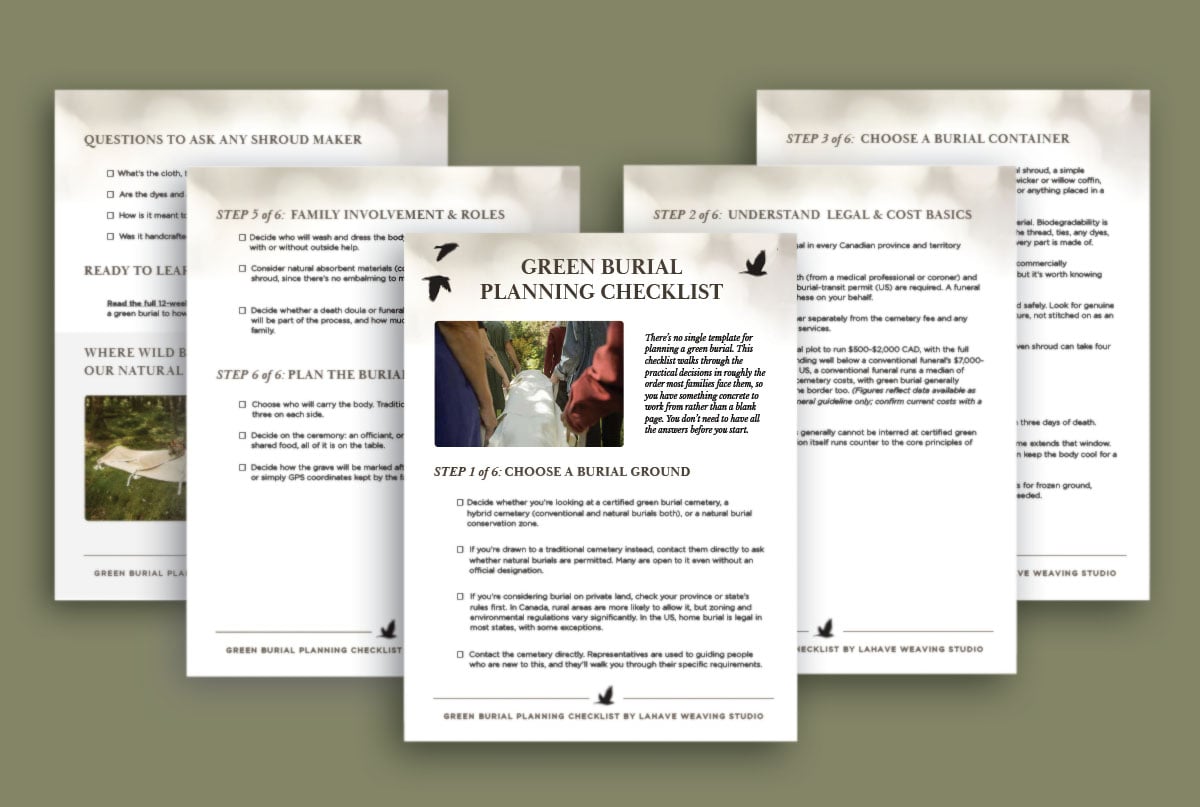
- A free Green Burial Planning Checklist
- What caring for the body at home actually involves
- How timing works when there is no embalming
- What a natural burial day can look like, shaped by the family
Natural burials are straightforward to arrange and for many families, the process itself becomes part of the farewell. This post covers what is involved in planning a natural burial.
Our Introduction to Green Burial is a good place to begin learning about natural burials and our Green Burial FAQs can help you find information about legal and financial requirements in your province or state as well as locations of natural burial grounds.
Plan Ahead
If you, your family member, or friend have decided on a natural burial, choosing where the burial will take place is a good first step. If you choose a green burial ground, the cemetery trustees are accustomed to guiding people who are new to all of this. If you are interested in a natural burial in a traditional cemetery, you would have to ask the cemetery officials if this is permitted. Cemetery representatives are often open to the idea of natural burials.
Depending on which province or state you live in, burial on private land may be permitted. It's also worth knowing that some burial containers, such as our hand crafted shrouds, take time to order and make. Although we try to keep a limited selection on hand, a custom shroud can take up to four to six weeks to weave, sew, and ship. Green burial is also generally more affordable than a conventional funeral, often significantly so. Our Green Burial, Cremation, or Traditional Funeral post has a full cost breakdown.
Contact a Natural Burial Ground
Contacting the cemetery is a good way to begin the planning process for a natural burial. The cemetery representative will walk you through their requirements and also present the choices that you have. See details in our Green Burial FAQs.
There are a variety of green burial options such as certified green or natural burial cemeteries, hybrid cemeteries which have conventional burials as well as natural burials, and natural burial conservation zones. Many conventional cemeteries are open to learning about natural burials and will then accept them.
What Can the Body Be Buried In?

The burial container (what the body will be buried in) is one of the first decisions you'll make and there are more options than most people realize.
Any container that is fully biodegradable will work. In practice that could mean a burial shroud, a simple untreated wooden coffin made with wooden fasteners, a wicker or willow coffin, or a sturdy cardboard coffin. It cannot be a sealed metal casket or anything placed in a concrete vault. The container you choose comes down to what feels right for the person being buried and your budget.
Download Your Free Copy of A Green Burial Planning Checklist
Caring for the Dead

Preparing a loved one for natural burial, by hand.
Most of us have never washed a body, let alone cared for one. Green burial changes that. For many families, it turns out to be the most profound part of the whole experience.
For many families, it turns out to be the most profound part of the whole experience.
The body can be washed and dressed at home, with or without outside help. It's also the part people approach with the most uncertainty, but what tends to happen when family members or close friends choose to be present for this, is something unexpected: a quietness, a tenderness, a sense of privilege in being trusted with this final act of care.
The feelings that come up are varied and all of them are normal. Grief, of course, but also calmness, gratitude, and space for everything in between.
Preparing the body involves washing, often with rose water or essential oils, cooling using ice packs, dry ice, and air conditioning, and wrapping the body in a biodegradable shroud or dressing the body in natural clothing. Because there is no embalming, fluid absorption is a practical consideration. Cotton batting or other natural absorbent materials can be placed inside the shroud to handle this. At LaHave Weaving Studio we offer natural wool batting within the shroud as an absorbent material. It is a quiet, practical and considerate act nested inside a larger process.
A funeral home with green burial experience can also coordinate as much or as little as the family needs. An end-of-life or death doula is a trained guide who supports families through the practical and emotional process of dying and end-of-life care. They can be present for the washing, the wrapping, the carrying, and the ceremony, or simply be available by phone when questions arise.
Timing of a Natural Burial after Death
Without embalming, timing a natural burial is an important factor. A body is usually buried within three days of death. Refrigeration at a funeral home extends that window comfortably if a longer wait is needed. At home, however, the use of dry ice, ice packs, or an air conditioner can keep the body cool for a few days. We cover why embalming isn't part of natural burial in our introduction to green burial, and go into more detail on keeping a body cool at home in our FAQ.
Some cemeteries have specific protocols for when frozen ground can make digging difficult. Specialty equipment and warming blankets may be needed in extreme cold.
What a Natural Burial Day Actually Looks Like

Fall leaves laid over a shroud, an adornment chosen by the family.
There is no template on how to host a green burial. Some families choose to gather at the graveside with a minister or priest or a non-religious celebrant. Others may choose to gather without any formal officiant at all, joined by people who loved this person, standing together on the land and reflecting on the life of the deceased.
There are many ways to honour the deceased person including singing with or without accompaniment, an instrumental piece, a poem read aloud, and wildflowers laid over the burial container as a final adornment. There could be lengthy silences, stories, some with laughter and some with tears, and the sharing of food afterwards.
Typically, the procession to the burial site is on foot. Six people chosen by the family carry the body, three on each side. The grave is dug in advance by the burial ground staff, family or friends. The body can be lowered by straps or ropes. After the burial, the earth is mounded gently and marked simply with a stone, a tree, a plant, or GPS coordinates kept by the family and recorded by the cemetery.
What most families say about natural burials is that it felt real and that the ceremony was shaped entirely by the people grieving, not by convention or a schedule set by a stranger. Families find they had time to say goodbye on their own terms, time with the body, time with each other, time to say what needed saying. Green burial gives that to those grieving.
The ceremony was shaped entirely by the people grieving, not by convention or a schedule set by a stranger.
If you are weighing these choices for yourself or someone you love, our Green Burial FAQs answers the questions most families have about legality, cost, and planning. And when the time comes to choose a shroud, you'll find us at the loom.
Continue the series: FAQs: Green Burials in Canada and the U.S.
New to the series? Start with What Is Green Burial?
Sources
- Timing of burial without embalming, body cooling, and winter burial protocols: Green Burial Council
- Biodegradable container requirements and direct earth burial without a vault: Green Burial Society of Canada
- Green burial standards in Nova Scotia: Green Burial Society of Nova Scotia
- Death doula role and home funeral guidance: National Home Funeral Alliance
Leave a comment