

What Is Green Burial?
This is the first in a 12-week series about natural burial: what it is, why it matters, and the shrouds we weave at LaHave Weaving Studio. We hope you will follow along and discover something new about green burial as we go.

A handwoven burial shroud, laid on the forest floor it will return to.
If you have heard the term "green burial" and want to understand what it actually means, you are in the right place. Natural burial, also called green burial, is one of the oldest ways humans have cared for their dead. It is gaining renewed interest across Canada and the United States and around the world as more people look for end-of-life choices that reflect their values: simplicity, sustainability, and a meaningful connection to the natural world.
What you'll learn in this post (8 min read)
- Why conventional embalming is optional, and what families can do instead
- How natural burial grounds actively restore and protect the land
- A free Beginner's Guide to Green Burial
- What a natural burial typically costs, compared to a conventional one
- Where to find green burial options in Nova Scotia and across Canada
A natural burial is an eco-friendly funeral option that returns a body to the earth naturally and with dignity, using biodegradable materials to avoid environmental contamination and promote ecological restoration.
At LaHave Weaving Studio, our Where Wild Birds Sing burial shrouds are designed specifically with natural burial in mind. Understanding the principles of natural burial is a good place to start to learn about this time-honoured method.
Here are the five key principles of natural burial:
1. No Embalming

No embalming means no chemicals between the body and the land, only the same forest floor as everything else that returns to it.
Conventional North American funerals often include embalming, a process that uses formaldehyde and other chemicals to temporarily preserve the body. Many families do not realize it is optional or that there is an environmental cost attached to it. Formaldehyde is a known carcinogen and the occupational health risks to embalmers who work with it regularly are well documented. When embalming chemicals enter the environment over time, they have the potential to affect surrounding soil and ecosystems.
Natural burial does not use embalming. The body is kept cool and cared for naturally until burial can take place, without conventional embalming chemicals, which is better for the land where the burial takes place.
Having a natural burial changes the experience of grief. Burial usually happens within a few days of death, close to the natural timeline, or, if more time is needed for family and friends to arrive, the body can be kept cool at home or using the service of a funeral home. Families have the option of caring for their loved one at home - they may wish to wash and dress the body and sit with them in a familiar environment with others who loved them. Their loved one is not taken away and prepared by strangers.
2. Direct Earth Burial

Carried by hand, by their loved ones who knew them best.
In a conventional burial the body is placed in a sealed casket, usually constructed from wood, steel, or plastic, which is then lowered into a concrete liner or vault to prevent the ground from settling, effectively separating the body from the earth entirely. A sealed metal casket can remain largely intact underground for decades, and a concrete vault can last far longer.
In a natural burial those barriers are removed. The body, wrapped in a biodegradable burial shroud (pictured above), and/or placed in a sustainable coffin, is laid directly into the ground. Decomposition happens naturally, nutrients return to the soil and the body becomes part of the ecosystem it is buried in.
A natural burial shroud like those we make at LaHave Weaving Studio is designed specifically for this: all natural fibres and trims, no synthetic materials, fully biodegradable.
3. Ecological Restoration and Conservation

A stand of hemlocks in Blockhouse, Nova Scotia, the kind of protected land natural burial helps preserve.
Many natural burial grounds in Canada and around the world are located within conservation land or protected natural areas, meaning your final resting place can actively contribute to the preservation of that landscape. Natural burials can also take place in a traditional cemetery where the stewards of that cemetery may designate a special area for these burials, making an effort to foster a natural, sustainable environment and adhere to the principles of natural burial.
Rather than a site maintained with chemicals and machinery, a natural burial ground is cared for by nature itself. Wildflowers grow, birds nest and native plants take root, and in some cases, burial fees directly support conservation efforts, making natural burial a genuinely final protective act for the land.
One of the most remarkable examples of this is Ramsey Creek Preserve in Westminster, South Carolina, the first conservation burial ground in North America. Founded in 1996 by physician Billy Campbell and his wife Kimberley, it began as a 33-acre former farm in need of restoration and today covers 78 acres, permanently protected through a conservation agreement with a land trust. It has served as a model for the movement across the continent, and Campbell describes its mission simply: "CPR for the land. Conservation, preservation, restoration." The vision, shared by the dozens of conservation burial grounds Ramsey Creek has inspired, is to restore and rewild one million acres through natural burial. That is not a small idea.
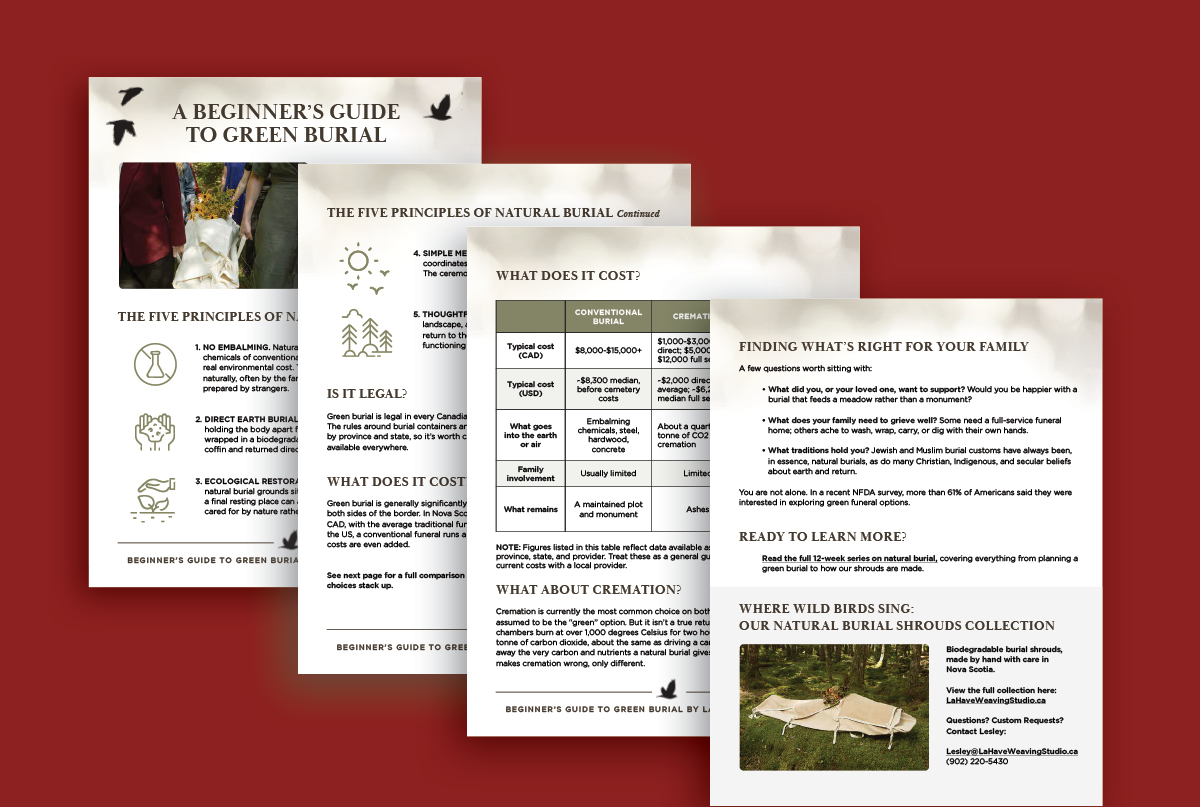
Download Your Free Copy of A Beginner's Guide to Green Burial
4. Simple Memorialization

Flowers laid by hand, in place of a headstone.
Natural burial moves away from elaborate, expensive funeral practices and toward something quieter and more personal, a ceremony or celebration shaped entirely by the people who are grieving, on their own terms and in their own time.
When someone we love dies, the conventions of the funeral industry can take over quickly. The body is removed, decisions are made by professionals, the schedule is set. Natural burial works differently. It returns the care of the dead to their living loved ones, creating space to slow down, to be present, and to say goodbye in a way that actually reflects who that person was.
Grave markers in natural burial grounds are typically modest. A native tree, a planted shrub, a simple native stone, or sometimes just a GPS coordinate kept by the family. There are no granite monuments, no bronze plaques, no perpetual-care contracts. What takes their place is something that cannot be purchased: the presence of the people who loved them.
These are not lesser versions of a funeral. For many families, they are more meaningful than anything a funeral home could arrange.
If the cost of choosing green burial over a conventional funeral is on your mind, you're not alone: it's one of the most common questions families ask. We break down real numbers, in both CAD and USD, in our honest comparison of green burial, cremation, and traditional funerals.
The ceremony itself is shaped by family and friends, not by convention. A song sung at the graveside. A poem read aloud. A procession through the land, walking together to the burial site. Green boughs or wildflowers laid under or over the shroud. The carrying of the body, three helpers on each side, by the people who knew them best. Silence, when words are not enough. A dance. A shared meal. Stories told over the open grave. Laughter, even.
These are not lesser versions of a funeral. For many families, they are more meaningful than anything a funeral home could arrange.
5. Thoughtful Use of Land

A marker made of stone, nothing more.
Where a conventional cemetery can impose itself on the landscape, a natural burial ground does the opposite. The body returns nutrients to the soil, native species take root, and the land continues to function as living habitat. No vaults, no monuments, no chemical maintenance - just land doing what land does when it is left to itself.
No vaults, no monuments, no chemical maintenance, just land doing what land does when it is left to itself.
Larkspur Conservation near Nashville, Tennessee shows what this looks like at its best. A nonprofit burial ground on 161 acres founded in 2018, it sits adjacent to one of the most biodiverse regions in the American South, permanently protected through a conservation agreement with The Nature Conservancy which monitors its ecological health every year. Invasive species are removed, native plants restored, and the preserve is open daily for hiking, bird watching, and quiet reflection. Each natural burial that takes place there directly funds that reforestation and restoration work.
"When I die, my body can be a seed," says Larkspur's founder John Christian Phifer. That is the principle, put plainly.
For those who care about how they move through the world, natural burial offers a way to carry those values all the way to the end, leaving the land in at least as good a condition as they found it. Quite possibly better.
Green Burial in Nova Scotia and Across Canada

The coast near Lunenburg, Nova Scotia, at dusk.
Natural burial is legal across Canada, though the specific regulations around transportation of the deceased, burial on private land, and the designation of green burial sites vary by province. If you are exploring options in Nova Scotia, the Green Burial Society of Nova Scotia is a helpful resource, as is Green Burial Canada.
In Nova Scotia, green burial options are growing. Sunrise Park Interfaith Cemetery in Hatchet Lake, near Halifax, is currently the province's only fully certified green burial cemetery. Burlington Cemetery in Burlington, near Berwick, has designated land specifically for natural burial, where grave sites are left to naturalize and marked simply, if at all. And something more significant is quietly taking shape behind St. Paul's Anglican Church in French Village, overlooking St. Margarets Bay, where a group of volunteers is working to establish Nova Scotia's first conservation burial ground on 11 hectares of woodland. Trails have been cleared, plant and bird species documented, and conservation status is being pursued. It is not accepting burials yet, but it is worth knowing about. The movement is here, and it is growing.
If you are considering a biodegradable burial shroud for a natural burial, we recommend planning ahead. Our handwoven shrouds are made to order and take time to make well, though we do keep some in stock for time-sensitive situations. Feel free to reach out at Lesley@LaHaveWeavingStudio.ca.
"and the trunk falls to the ground
and the moss covers it
and in the spring the rabbits find it
and build their nest inside the dead tree
so that nothing is wasted in nature
or in love."
— Laura Gilpin, "Life After Death"
Whatever shape a farewell takes, it can be made by hand and made with care. When you're ready, you'll find us at the loom.
Continue the series: Your Guide to Planning a Green Burial
Sources
- Photography: Chris Geworsky | geworsky.com
- Formaldehyde classified as a known human carcinogen: National Institute of Environmental Health Sciences (NIEHS)
- Casket decomposition timelines: Dalton Hoopes Funeral Home
- Ramsey Creek Preserve history and mission: Memorial Ecosystems
- Ramsey Creek conservation easement and Green Burial Council certification: Green Burial Naturally
- Larkspur Conservation land protection and Nature Conservancy partnership: City Cast Nashville
- Larkspur Conservation mission and founder quote: Atmos
- Nova Scotia green burial options and certification: Green Burial Society of Nova Scotia
- St. Paul's Anglican Church French Village conservation burial ground: CBC News
- Conventional vs. green burial costs in Canada: Funeral Homes Nearby
Leave a comment