

FAQs: Green Burials in Canada and the U.S
This is part three of our 12-week series on natural burial. New here? Start with Intro to Green Burial or our previous post, Your Guide to Planning a Green Burial.

Flowers being laid as adornment on a burial shroud.
Understandably, planning a green or natural burial raises a lot of questions. Some questions are practical like the costs, legality, and logistics while other questions are more personal and harder to know what to ask. All questions about green burials are valid and worth asking. This guide covers some basic and commonly-asked questions about green burials but, if in doubt, it is best to ask the provincial or state departments in your area or engage someone who is knowledgeable about green burials.
What you'll learn in this post (8 min read)
- Whether green burial is legal in Canada and the US
- What green burial costs
- How to find a green burial ground near you
- Whether you can bury on private land
- A free Beginner's Guide to Green Burial
- How deep a natural grave is dug
- Keeping the body cool at home
- Why cremation and green burial don't mix
- How graves are marked
In Nova Scotia the Green Burial Society of Nova Scotia has a very informative website and small businesses such as Dawn Carson and Deborah Luscomb at Death Matters or Louisa Horne at Epilog can provide advice and guidance about planning after-care death and what is allowed and not allowed in Nova Scotia. Funeral homes will also have answers to many of your questions.
Whether you just finished reading our Introduction to Green Burial or Your Guide to Planning a Green Burial or if you landed here with a specific question already in mind, you're in the right place.
Green Burial Is Legal in Canada and the USA. Here's What You Need to Know
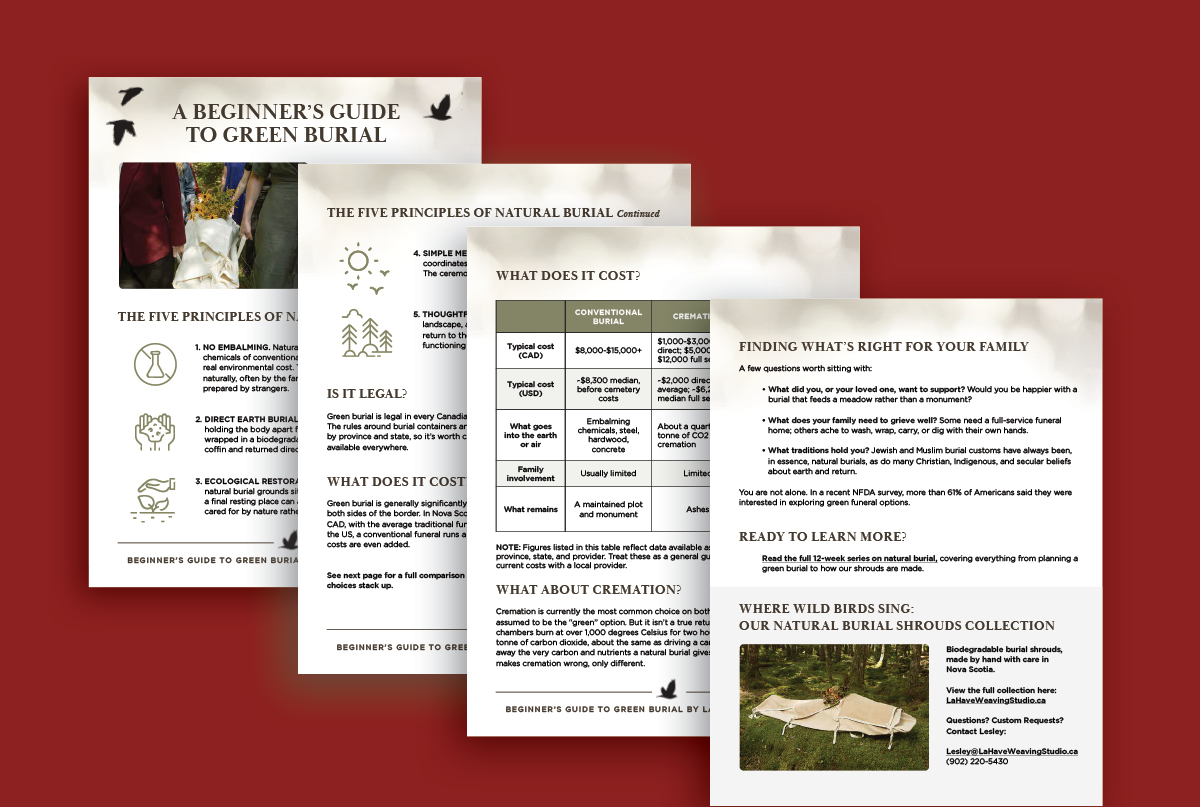
Typically, the first thing most people want to know is whether or not green burial is legal. In every Canadian province and territory and in all 50 US states, green burial is legal. However, the rules around burial containers and where exactly you can bury your loved one, vary by province and state.
In most Canadian provinces the burial needs to happen in a licensed cemetery unless you meet specific conditions for a private land burial. We'll talk more about this later in this article.
What Green Burial Costs
Cost is usually the second question that comes up and the answer tends to surprise people. Green burial is, generally, significantly more affordable than a conventional funeral. Conventional funeral costs in America are comparable to Canadian costs, though they vary considerably state by state.
When someone dies a medical certificate of death is required from a medical professional or coroner and a burial permit (in Canada) or a burial-transit permit (in the USA) must be obtained. A funeral home can submit these documents on your behalf.
Prices for burial plots and funeral home services vary widely as do prices in urban and rural areas. In Nova Scotia a burial plot can run from $500 to $2,000, and the average traditional funeral is estimated at around $7,000 to $10,500, climbing higher for elaborate services. It is interesting to note that corporate funeral companies have been acquiring independent funeral homes in Canada at a great rate.
A home funeral or wake is where you care for your deceased loved one at home, and then they would be transported to a burial site. The costs could be as simple as having the death registered and a burial permit obtained by a funeral home and just the cost of the burial plot. Digging the grave could be done by friends and family, a simple native stone could be laid at the grave, a tree planted, or the deceased's name and dates simply listed on the cemetery's records.

Whether you choose a shroud, an untreated wooden coffin, a cardboard coffin, or a wicker casket, the burial container is always priced separately, in addition to the cemetery fee and the services of a funeral home or end-of-life provider. If you happen to be considering one of LaHave Weaving Studio shrouds it is important to understand that, although we always try to have some shrouds on hand, it may take between four to six weeks to make a custom shroud and ship it. Planning ahead and reaching out early provides you the most options for your shroud. If the cost of a handwoven shroud feels like a stretch right now, monthly payment plans are available through Shop Pay at checkout. Terms are shown based on your own eligibility before you commit to anything.
Finding a Green Burial Ground Near You
Certified green burial grounds are becoming more accessible and growing on both sides of the border. Great Britain leads the way with hundreds of woodland and natural burial sites, the United States has hundreds of green burial cemeteries and hybrid sections, and there are dozens of certified and hybrid green burial sites across Canada (Green Burial Society of Canada).
In Canada, the Green Burial Society of Canada directory lists certified cemeteries and funeral providers searchable by province. TalkDeath.com maintains a province-by-province breakdown covering all thirteen provinces and territories. In Nova Scotia the Green Burial Society of Nova Scotia lists natural burial cemeteries, under 'local resources'.
For American families the Green Burial Council maintains an equivalent directory across all fifty states and the National Home Funeral Alliance is a valuable resource for families wanting to handle more of the process themselves.
In Nova Scotia options include Sunrise Park Interfaith Cemetery in Hatchet Lake, Halifax County currently the province's only fully certified green burial cemetery. One of the several options for natural burials listed on the Green Burial Society of Nova Scotia's site is Burlington Cemetery in Burlington, Kings County and behind St. Paul's Anglican Church in French Village, Halifax County volunteers are working steadily to establish Nova Scotia's first conservation burial ground on 11 hectares of woodland.
In Ontario the Natural Burial Association is actively expanding access and in British Columbia the Natural Burial Cooperative is doing the same. For everywhere else, greenburialcanada.ca is the most comprehensive starting point and the list is growing every year.
Burying on Private Land

A private burial site, overlooking the ocean.
Although it is sometimes possible to have yourself or a loved one buried on private land in Canada and the United States, it requires some research. It is important to understand the rules before you commit to choosing this option and you'll need time to gather any approvals or permits needed. In Canada rural areas are more likely to allow a natural burial on private land but zoning laws and environmental regulations vary significantly by province. In the United States home burial is legal in most states, with some exceptions. This guide covers private burial laws province by province in Canada and the Green Burial Council FAQ covers the US side.
In Nova Scotia we have the Cemetery and Funeral Services Act. A direct conversation with your local municipal office and the Dept. of Environment and Climate regarding a permit is the most dependable way to find out what applies to your specific situation.
Download Your Free Copy of A Beginner's Guide to Green Burial
Depth of the Grave
Conventional graves are usually dug around five to six feet deep whereas natural or green burial graves are dug around three feet deep. This depth prevents any animal disturbances of the grave and according to Larkspur Conservation, "this more natural depth allows for greater interaction with living soil rich in bacteria, fungi, and microorganisms that support natural decomposition and return".
Decomposition of the body varies greatly depending on soil condition, climate, geology, hydrology, etc. Also, it depends whether the body is in a undyed natural fibre shroud, a sturdy cardboard coffin, an untreated wooden coffin, or a natural willow casket, the latter two taking substantially longer to decompose. We go into more detail on how direct earth burial works in our introduction to green burial.
How long this takes depends heavily on soil conditions, climate, and the materials used. Natural fibres like undyed linen, cotton, and wool break down relatively quickly, within weeks to months, while a willow or untreated wooden coffin takes considerably longer. Synthetic materials like polyester can persist for decades, which is exactly why they have no place in a natural burial.
Keeping the Body Cool at Home
The use of formaldehyde and other embalming chemicals are not in keeping with green burial principles. They are carcinogenic and pollute the body and the earth for years to come. Read more about why natural burial skips embalming entirely.
Keeping a body cool for burial at home is more manageable than you might expect.
It is the most important and practical consideration in the hours and days after death. Placing regular frozen gel packs under and around the torso is the easiest and most accessible option to keep the body cool. Other options are keeping the room as cool as the season will allow, opening windows, using dry ice, or using an air conditioner. The goal is to keep the core of the body cool, not to freeze it.
In most circumstances this gives a family a few days to gather, grieve, and say goodbye without rushing. For longer periods of waiting refrigeration of the body at a funeral home is an option. A death doula or after-life care provider can also guide your family through exactly what to do and when. For a closer look at what caring for a loved one at home actually involves, see our planning guide.
What About Cremation?
One thing that surprises a lot of people is that cremation and natural burial don't mix. At most certified green burial grounds, cremated remains can't be interred due to the environmental impact of cremation. Cremation requires considerable energy and releases significant emissions which runs counter to the core principles of green burial.
Cremation and natural burial don't mix.
How the Grave Is Marked in a Natural Burial Ground

A large granite stone, chosen to mark this site.
Green burial grave markers are, by nature, simple. A native tree planted, a native stone, engraved or not, a communal list kept by the cemetery or, in some cases, just a GPS coordinate kept by the family and recorded by the cemetery. Unlike a traditional burial ground there are no granite monuments or plaques and no ongoing maintenance contracts to keep grounds manicured indefinitely. In a natural burial ground the land is left to naturalize and this means that the earth returns gradually to its natural state with birds and wildlife present and native plants and wildflowers taking root over time. The land itself becomes the memorial.
The land itself becomes the memorial.
Ready to take a next step? Start with our guide to planning a green burial, then make that first call to your local cemetery or a green burial ground in your area. You don't need to have all the answers before you pick up the phone. And when the time comes to choose a shroud, you'll find us at the loom.
Continue the series: What Is a Natural Burial Shroud?
New to the series? Start with What Is Green Burial?
Sources
- Nova Scotia funeral cost averages: Canadian Funerals Online; Eirene
- Green burial legality across Canada: Green Burial Canada
- Green burial legality across the US: Green Burial Council FAQ
- Province-by-province directory: Green Burial Society of Canada
- Province-by-province breakdown: TalkDeath.com
- US provider directory: Green Burial Council
- Home funeral guidance: National Home Funeral Alliance
- Private land burial rules in Canada: Funeral Homes Nearby
- Green burial in Nova Scotia: Green Burial Society of Nova Scotia
- St. Paul's Anglican Church French Village: CBC News
- Body cooling techniques: Peaceful Passage at Home
- Ontario green burial advocacy: Natural Burial Association
- BC green burial advocacy: Natural Burial Cooperative
Leave a comment