

Green Burial, Cremation, or Traditional Funeral?
This is part five of our 12-week series on natural burial. New here? Start with Intro to Green Burial or read our previous post, What Is a Natural Burial Shroud?

Before we get into this post we must be clear that there is no wrong choice with whatever you choose for end of life planning for yourself or a loved one. Funeral arrangements carry the weight of tradition, faith, family expectation, and grief. Most of us want to say goodbye in a way that is authentic and meaningful to yourself or a loved one. The goal of this post is to highlight what each end-of-life choice entails to help you with your planning.
What you'll learn in this post (8 min read)
What a Traditional Funeral Actually Involves
A conventional funeral in Canada or the US typically includes embalming, a viewing or visitation at a funeral home, a casket, a ceremony, and burial in a cemetery plot, often with a concrete grave liner or vault, and a granite monument.

An example of a traditional funeral using a casket.
Each of those pieces has a cost, and the costs add up quickly. We cover the full cost picture for both Canada and the US in our green burial FAQ. Although we won't repeat the numbers here, the short answer is that a conventional funeral with burial commonly runs well into five figures on either side of the border once the casket, plot, and monument are included. Nearly half of Canadians say they worry about being able to afford a funeral, and it's no wonder considering those costs.
There is an environmental cost to consider as well, and it's rarely mentioned during funeral arrangements. Embalming relies on formaldehyde-based chemicals, and the caskets and vaults that go with a conventional burial add hardwood, steel, and reinforced concrete to the ground. A conventional cemetery becomes a place where a great deal of material is buried that was never meant to break down, which is, in fact, by design. Sealed caskets and vaults exist to slow decomposition, sometimes indefinitely.
A conventional funeral with burial commonly runs well into five figures on either side of the border.
There's a quieter cost too, harder to put a number on. In a conventional arrangement, most of the care of the body passes to professionals. For some families that is a relief, but for others, it leaves a feeling of distance, of having been a guest at their own person's goodbye.
Writer Janet Siroto described the opposite experience in an essay for Next Avenue. At her friend Carla's green burial, she and her family carried and lowered the body themselves, feeling its weight, honoring exactly what Carla had chosen for herself: a direct, unshielded return to the earth. Siroto wrote that it was jarring in the moment, and also the thing she will always remember, the most elemental way of saying goodbye, the way our ancestors did for generations. Not every family wants that closeness. But many who have had it describe it the way she does.
What About Cremation?
Cremation is currently the most common choice on both sides of the border. More than three quarters of Canadians who die are now cremated, and the American rate has passed 63 percent, with industry projections putting it above 80 percent within twenty years. It's flexible, familiar, and usually cheaper than a conventional burial: a direct cremation runs $1,000 to $3,000 CAD in Canada and averages roughly $2,000 USD in the US, while a full-service cremation funeral runs $5,000 to $12,000 CAD, with a US median around $6,280 USD.
Cremation is often assumed to be the green choice, and compared to a vault-and-casket burial, it is lighter. But it isn't a return to the earth. Cremation chambers burn at 650 to over 1,000 degrees Celsius for around two hours, releasing roughly a quarter of a tonne of carbon dioxide, about the same as driving a car 980 kilometres. The heat also strips away the body's carbon and nutrients, the very things a natural burial gives back to the soil. What a family receives afterward isn't ash from a fire, it's bone fragments, ground into fine, uniform remains. None of this makes cremation the wrong choice, only a different one. For families weighing green burial vs cremation in Canada or the US, the real question is usually less about cost than about what feels right, which we'll return to at the end of this post.
What Natural or Green Burial Involves

Six people carrying the Snowy Owl Burial Shroud to a natural burial site.
A natural burial removes the necessity of embalming, a sealed casket, and the vault. The body is wrapped in a biodegradable cloth shroud or laid in a simple, untreated wooden coffin and returned to the earth, where the living layer of the soil can do what it has always done: decompose. We have covered the depth, the grave markers, and the legal side in our introduction to green burial and our green burial FAQ, so what matters here is simply how it sits beside the other two options: less manufactured, not sealed, more of a genuine return.
The costs are generally modest because the materials are modest. Our green burial FAQ covers current ranges for both countries. The savings come from what is simply not purchased: no embalming, no manufactured casket, no vault, no monument. If the cost of a handwoven shroud feels like a stretch right now, monthly payment plans are available through Shop Pay at checkout. Terms are shown based on your own eligibility before you commit to anything. Families may wash and dress their deceased loved one and wrap them in the shroud (or natural burial container of their choice). The body is then carried by hand with the help of family and friends to the grave site, lowered into the grave, and the grave may be filled with soil by those who wish to.
With natural burial, families can take their time to do the planning themselves, whether it includes music, poems, readings, flowers or boughs, a church service, or silence. The services of a death care planner or a funeral home may be used to complete certain stages. Whether you carry out the natural burial yourself or with help from a provider, it is all legally permitted in Canada and the United States. For many families, that permission turns out to be the gift.
For many families, that permission turns out to be the gift.
How the Three Options Compare
Numbers vary by province, state, and provider, and they change over time, so treat these as ranges rather than quotes. Canadian figures are in CAD and American figures in USD. The pattern across these burial options in Canada and the US, though, is consistent on both sides of the border. Natural burial vs conventional burial offers these positive features:
- ✓Natural burial usually costs less.
- ✓Natural burial does not harm the environment; it gives back to the environment in nutrients from the body, the natural shroud fibres, or untreated native wood, as well as often enriching the land with native plantings and land restoration efforts.
- ✓Natural burial offers family and friends a degree of closeness, time to sit with and reflect upon the deceased loved one, and as much involvement as you wish.
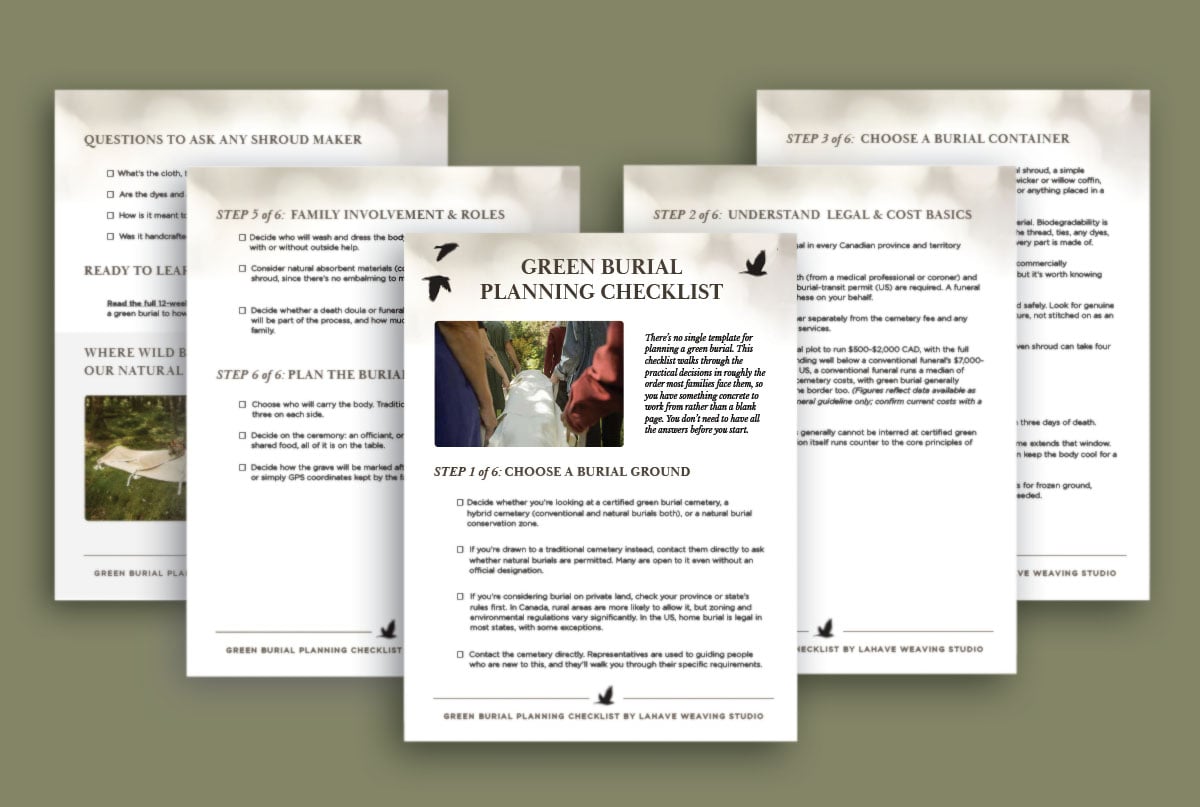
Download Your Free Copy of A Green Burial Planning Checklist
How to Think About Which Option Fits Your Family

Tall, hemlock trees in Blockhouse, Nova Scotia. Photo by Chris Geworsky.
To many people, cost matters and the environment matters, but another deciding factor is what kind of end-of-life disposition you would like for yourself or for your loved one.
A few questions worth pondering:
- What do you or your friend or family member want to support? Were you, or they, happiest in a garden, on the water, or in the woods? Did they enjoy wild birds and animals? Would you, or they, be happier with a burial that feeds a meadow rather than erecting a monument?
- What does your family need in order to grieve well? Some families need the structure and support of a full-service funeral home. Others ache to do something with their hands: to wash, to wrap, to carry, to dig, or arrange the ceremony in their own way.
- What traditions hold you? Jewish and Muslim burial customs have always been, in essence, natural burials. Many Christian, Indigenous, and secular families find that green burial sits comfortably alongside what they already believe about earth and return.
Practically, is there a green burial option near you? There are traditional cemeteries that welcome natural burials, certified green burial grounds, and conservation green burial cemeteries. Natural burial is legal in every Canadian province and territory and in all fifty US states. Dedicated sites are growing across the continent, including here in Nova Scotia.
You are not alone in your curiosity, either. In the most recent NFDA consumer survey, more than 61 percent of Americans said they were interested in exploring green funeral options, up from 55.7 percent four years earlier.
"And so thy thoughts, when thou art gone, love itself shall slumber on."
— Percy Bysshe Shelley
If you are weighing these choices for yourself or someone you love, our green burial FAQ answers the questions most families have about legality, cost, and planning. And when the time comes to choose a shroud, you'll find us at the loom.
Continue the series: What Is a Death Doula?
New to the series? Start with What Is Green Burial?
Sources
- Funeral affordability in Canada: Seniors Choice Cost of Dying Report (2024), seniorschoice.ca/funeral-costs
- Canadian cremation rate: Cremation Association of North America, Industry Statistical Information, cremationassociation.org
- US cremation rate, projections, and green burial interest: National Funeral Directors Association, 2025 Cremation & Burial Report and 2025 Consumer Awareness and Preferences Report, nfda.org/media-center
- US funeral and cremation costs: NFDA 2023 General Price List Study; Funeralocity direct cremation pricing (2025)
- Cremation emissions and energy use: David Suzuki Foundation, "Green End-of-Life Options", davidsuzuki.org
- Natural burial cost ranges and accessibility: The Narwhal, "The Barriers to Green Burials in Ontario" (2026)
- Embalming fluid, hardwood, steel, and concrete figures: Green Burial Council / Cleo Cremation, "Green Burial and Eco-Friendly Funeral Options"
- Green burial in Nova Scotia: Green Burial Society of Nova Scotia, deathmatters.ca
Leave a comment