

How to Talk to Your Family About Green Burial
This is part seven of our 12-week series on natural burial. New here? Start with Intro to Green Burial, or read last week's post, What Is a Death Doula?

Two friends, sharing coffee and conversation.
Many of us raised in modern North American culture don't talk about planning our end-of-life arrangements and are uncomfortable discussing our death within our family. If the thought of raising the topic of planning a natural burial with the people you love makes you cringe a little (or a lot), you're in good company, and you're in the right place.
What you'll learn in this post (7 min read)
Why These Conversations Feel Harder Than They Are
The reassuring part of talking about what we want after our death is almost never about the actual wishes, but about how to start the conversation. The numbers show just how universal that reluctance is. In Canada, around six in ten adults have spoken to a family member about their end-of-life wishes, a figure that has climbed sharply in recent years. In the United States, The Conversation Project has long found the same telling gap. Roughly nine in ten people say talking about end-of-life care matters, but only about a third actually have.
Nearly everyone believes the conversation matters, and nearly everyone puts it off. So, if you've been carrying this around, you're not avoiding something other people find easy. You are facing the exact thing almost everyone finds hard. And by reading this, you're already further along than most.
Nearly everyone believes the conversation matters, and nearly everyone puts it off.
The other reason it feels heavy is that we tend to picture it as one enormous, tearful conversation, a single sit-down where everything must be said. It almost never works that way, and it doesn't need to. The best of these talks are small, ordinary, and repeated.
It helps to remember, too, that this unease is recent, not permanent. Within living memory here in Nova Scotia, particularly in the Gaelic communities of Cape Breton, death was tended close to home. Families washed and dressed their own dead, neighbours came to sit with them, and the conversations we now find so difficult were simply part of life. We wrote about that history in our guide to burial shrouds. The discomfort many of us carry today is a fairly new one.
How to Bring It Up Without It Feeling Awkward
The gentlest way to approach a discussion about planning for your death is during a walk, a drive, doing dishes together, the quiet in-between moments where eye contact is optional. Happily, green burial gives you a softer entry point than death itself, because what you're really talking about is nature, your values, and how you want to be remembered.
You don't need a script. Perhaps you watched a movie or documentary about someone dying, or a friend's funeral felt too cold, or you're walking past a cemetery, these are all good openings to bring up your own wishes for a natural burial. Nowadays there are magazine articles, news stories, and social media posts about green burials and other alternatives to embalming and an expensive casket. You could start by saying, "That got me thinking about what I'd want. Can I tell you?"
I have two friends who decided to read a book on all of the ways you could choose to deal with your body after you die. Each week they read a chapter, and each Saturday they discussed it over coffee.

Reading up on all the ways there are to deal with your body after you die.
Often, they went on field trips to do more research, and one field trip was to come to our studio, see our burial shrouds, and talk about them. So, you might have discussions with your friends as well as your family.
Notice that none of this demands a decision in the moment. It opens a door and leaves it open. That's the whole job of the first conversation: not to settle anything, just to make the subject approachable.
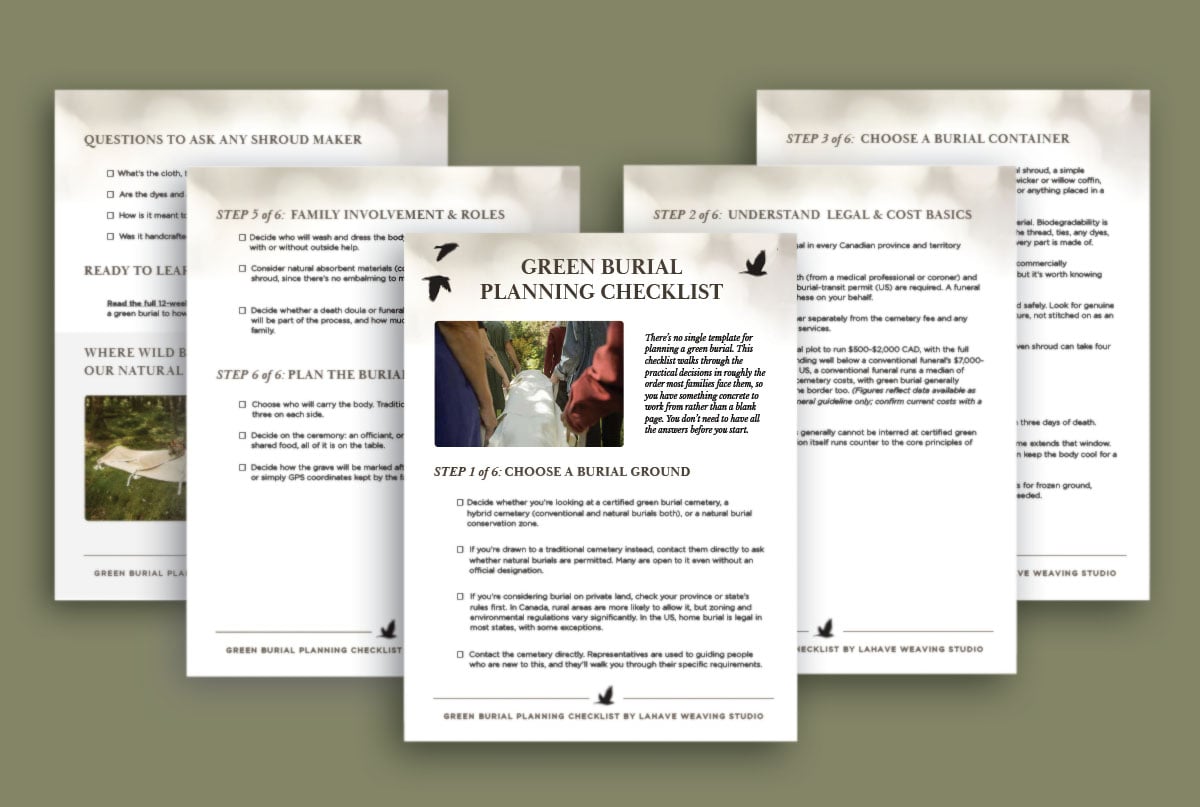
Download Your Free Copy of A Green Burial Planning Checklist
What to Say to a Partner, a Parent, or an Adult Child
With a partner, it's often a mutual exchange to talk about your end of life plans. You're not informing them so much as deciding together, and it can be surprisingly tender, two people imagining how they'd care for each other at the end. Framing it as planning you do side by side, like a will or a mortgage, takes away uncertainty about the future and can be discussed as many times as you need as you both learn more about the choices.
With a parent, the trick is to follow rather than lead. Many older adults have thought about death far more than their grown-up children realize and are quietly relieved when someone finally lets them talk about it. "Have you ever thought about what you'd want?" invites them in, rather than, "All of us have been talking to each other, and this is what we think is best for you and Dad." If your parent is the one drawn to a natural burial, your job may simply be to listen and reassure them you'll honour their wishes.
When talking to an adult child about your end-of-life plans, the fear is usually theirs, not yours, which often leaves it to you to raise the subject.

A family conversation, at home.
Younger family members may resist the conversation because it forces them to picture losing you. Naming that gently helps: "I know this isn't easy to hear, and we don't have to decide anything today. I just want you to know what matters to me, so you're not left guessing." That last part is the real gift you're offering, the relief of not having to guess in a moment of grief.
That last part is the real gift you're offering, the relief of not having to guess in a moment of grief.
If you feel that you need help talking about plans for care after your death, this is exactly one of the things that an after-death-care provider or a death doula is trained for, gently helping a person put their wishes into words and helping everyone else hear them.
How to Keep the Conversation Open Over Time
The best version of discussing your care after death is not one discussion but many. The goal of any single conversation is modest: leave the door open for the next one.
Treat it as ongoing, not final. Wishes change, and saying so out loud, "This is what I think today, and I'll tell you if that changes," makes the topic feel safe to revisit rather than written in stone. A green burial family conversation works best as a thread you return to, not a knot you tie once.
Write something down. Even a few lines turn a fragile memory into something a family can actually hold onto later, and the difference it makes is hard to overstate.

Writing down what matters, while there's time.
When the writer Mallory McDuff's father sat down to write his final wishes, it wasn't during some calm, unhurried moment, it was one month after his wife died suddenly. He was still in the best shape of his life, fresh off hiking the Appalachian Trail with her. He said, "I want a funeral that relies on family and friends," and spelled out the rest: a pine casket, his late wife's linens for a shroud, his bluegrass band at the graveside, and shovels so that young and old could close the grave together. When he died suddenly two years after her, his daughter was spared the agony of guessing. She knew exactly what he wanted, because he had told her plainly, years before anyone thought they would need it. Our green burial planning guide and FAQ can give your own note some structure.
Let it be light where it can be. These conversations are allowed to include laughter; some of the warmest end-of-life talks are full of it. You are planning a continuation of a life well loved, not rehearsing a tragedy.
"Under the wide and starry sky,
Dig the grave and let me lie.
Glad did I live and gladly die,
And I laid me down with a will.
This be the verse you grave for me:
Here he lies where he longed to be;
Home is the sailor, home from sea,
And the hunter home from the hill."
— Robert Louis Stevenson, "Requiem"
If these talks lead your family toward a natural burial, our planning guide walks through what comes next. And when the time comes to choose a shroud, you'll find us at the loom.
Continue the series: Choosing a Natural Burial Shroud: What to Look For
New to the series? Start with What Is Green Burial?
Sources
- Canadian end-of-life conversation rates: Advance Care Planning Canada / Canadian Hospice Palliative Care Association, national polls, advancecareplanning.ca
- US importance-versus-action gap on end-of-life conversations: The Conversation Project national surveys, theconversationproject.org
- Mallory McDuff and her father's directives: "Leaving a Legacy, Not an Impact," Vanderbilt Magazine; McDuff, Our Last Best Act (Broadleaf Books)
- Benefits of advance care planning conversations for families: The College of Family Physicians of Canada, cfp.ca
Leave a comment