

From Shroud to Soil: How Natural Fibres Return to Earth
This is part ten of our 12-week series on natural burial. New here? Start with our Introduction to Green Burial or check out our previous post, The Art of Weaving a Burial Shroud.


Wool on the warping mill, ready for weaving, and the zero-waste construction it becomes.
Every shroud we weave will, one day, disappear completely. That's not a flaw in the design. It's the whole point.
In How to Choose a Natural Burial Shroud, we named the natural fibres that belong in a shroud, and the synthetics that don't. This is where we go deeper into why, and what actually happens to each shroud after it's in the ground.
What you'll learn in this post (9 min read)
What "Biodegradable" Actually Asks of a Fibre
Although most cloth is designed to last, the woven cloth in our shrouds is intentionally designed not to last. One of the most important jobs any natural burial shroud has is that it must be able to fully return to the earth. That job doesn't really end until years later, underground, after doing the quiet work of decomposing and slowly becoming soil, while also leaving something good behind for the earth.
The question "what's it made of" isn't really about texture or cost. It's about what happens to the cloth once nobody's watching.
Not every natural fibre does this at the same speed, or in the same way, and that's part of why LaHave Weaving Studio uses several purely natural fabrics. Wool breaks down and feeds the soil with nitrogen and sulphur as it breaks down, research on wool biodegradation shows that it acts more like a fertilizer than simply decaying. Linen disappears fastest, a composting study found linen fabric is among the quickest natural fibres to fully break down in soil. Both wool and linen stand in stark contrast to synthetic fabric, which the US EPA's textile waste data shows piling up by the millions of tons in landfills, shedding microplastic fibres into water and soil for generations before it's gone.
So the question "what's it made of" isn't really about texture or cost. It's about what happens to the cloth once nobody's watching anymore.
Linen Returns to Where It Started
Linen has wrapped the dead for thousands of years, and there's something fitting about a fibre with that history being woven into our burial shrouds today. Our linen is Belgian, and it proudly carries European Flax certification, this certification is currently being renamed 'Masters of FLAX FIBRE', as it rolls out, with the same guarantee underneath: every step of production can be traced from field to finished yarn. That certification exists because flax genuinely earns it. Grown mostly on rainfall alone, it uses a fraction of the water cotton needs to produce the same weight of fibre and far fewer pesticides.
The Sandpiper is woven entirely by hand on a wooden loom in 100% Belgian linen, using an old towelling weave structure, a construction method traditionally used for absorbent textiles like towels. Lesley first found the technique in weaving books from the 1940s and 50s, and reworked it into the soft, circular motifs featured in the Sandpiper. No dye, just linen on linen.


From the flax field to the finished Sandpiper Shroud.
Wool: The Fibre Canada Can't Seem to Value
The Snowy Owl is currently woven in either 100% New Zealand wool, or a limited run of 100% Canadian wool spun in New Brunswick, undyed, in a gently undulating twill that carries, in Lesley's words, "a beautiful warmth, cosy and comforting." It's also the cloth most cemeteries with the strictest rules accept first: they know it breaks down completely, and fast.


From raw fleece to woven cloth: the Snowy Owl Shroud's wool.
Studies on wool's biodegradation don't just show it disappearing, they show it acting as fertilizer: wool buried in test plots measurably increased plant growth compared to untreated soil, the nitrogen and sulphur locked in the fibre feeding whatever grows above it.
Interestingly, Canadian wool is the hardest of all our fibres to actually source. Lesley's watched the problem flip over her career: early on, it was hard to find wholesale pricing at all; now wholesale exists, but suppliers require minimum orders sized for an operation much bigger than hers, a single studio that weaves a few dozen shrouds each year. Lesley samples every new fibre source by hand, placing a small trial order first, then she tests for hand and drape (how a finished fabric falls and rests under its own weight), before committing to anything larger.
Canadian farmers are paid so little for raw wool that many simply burn it rather than pay to have it hauled away.
Canadian farmers are paid so little for raw wool that many simply burn it rather than pay to have it hauled away.
Statistics Canada's most recent figures put the average price paid to Canadian wool producers at under fifty cents a kilogram. The Campaign for Wool, launched in Pictou, Nova Scotia, and still patroned by King Charles III, exists specifically to close the gap between what wool is worth environmentally and what it's actually worth to the farmer. That second number is called the farm gate price, the amount a producer is paid directly, before anyone else marks it up. Until that changes, most Canadian weavers, Lesley included, end up sourcing wool from New Zealand or elsewhere instead.
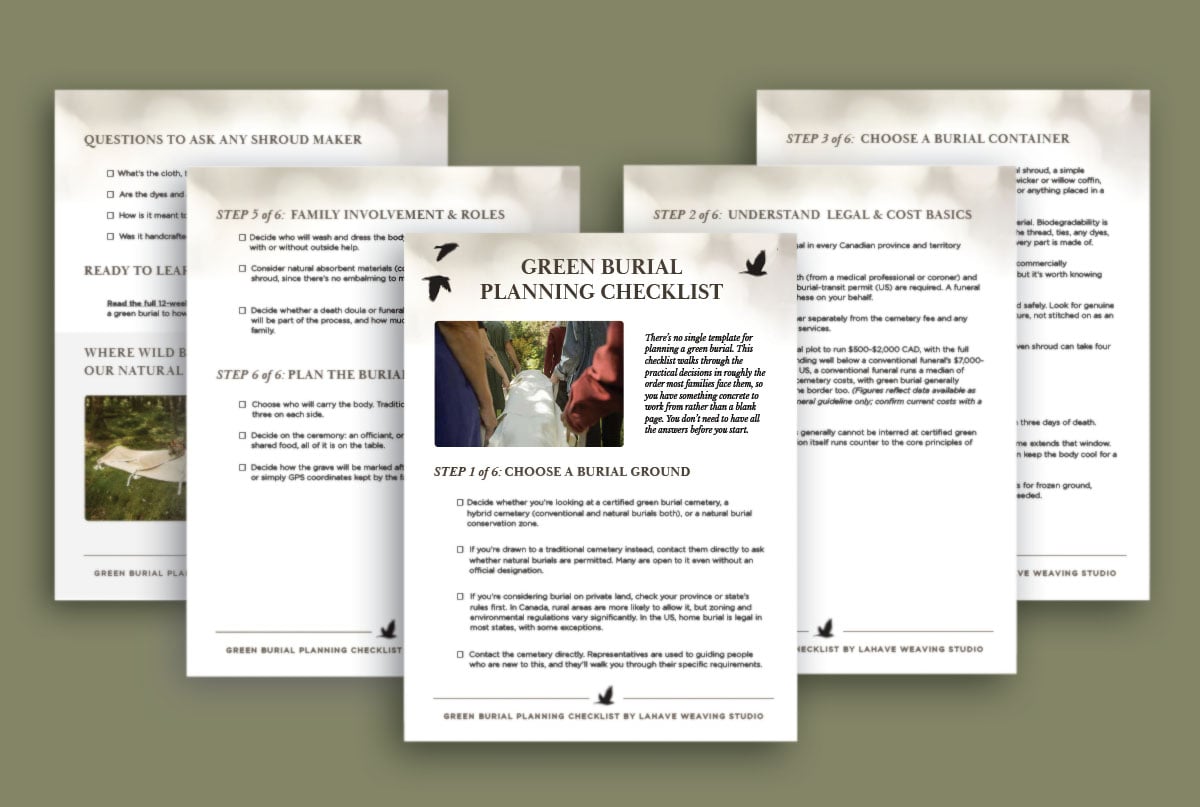
Download Your Free Copy of A Green Burial Planning Checklist
Cotton and Linen, Together
The Piping Plover and the Osprey blend organic cotton with natural linen, a 50/50 cotolin spun in Quebec. Both come off the loom surprisingly soft, the Piping Plover is woven in a soft twill in sandy tones inspired by the shorebird it's named for, the Osprey is woven in bolder herringbone (a V-shaped weave). Some of that cotton, when Lesley can get it, is a naturally-coloured organic cotton called 'Foxfibre' which is bred by Sally Fox, whose decades of work, starting in the early 1980s, produced cotton that grows naturally in tan and green shades. No dye, no wastewater, no chemical processing, just the colour the plant already carries.


Naturally-coloured Foxfibre®️ cotton grown by Sally Vreseis Fox and photo by Sally Vreseis Fox, paired with the Osprey Shroud's cotolin weave.
Why "Natural-Looking" Isn't the Same as Natural
A label can say cotton, linen, or "eco" without the cloth actually being what it claims. Commercially manufactured shrouds sometimes blend in polyester for strength or drape, and unless a buyer asks directly, there's often no way to tell from a product photo or a marketing description alone. It's part of why Lesley samples every yarn source herself before committing to it, testing what's actually in her hands rather than trusting a spec sheet. The same scrutiny is worth bringing to any shroud, handwoven or not, ask what's really in the cloth, not just what the label implies.
What's Next for Where Wild Birds Sing Burial Shrouds?
Lesley's currently experimenting with hemp, silk, and alpaca fibres. Although these fibres are not yet available in the Where Wild Birds Sing collection, there's already customer interest in them for custom burial shroud orders. She's slowly developing a custom hemp shroud sized for a large dog, since hemp's particular strength suits that scale of use well. The alpaca she sources from a mill in Peru she's worked with for years, a country that supplies the vast majority of the world's alpaca fibre and where fibre-traceability programs, tracing wool literally back to the farm, have become standard in a way Canadian wool still hasn't caught up to. A small, telling contrast: the fibre travelling the farthest is sometimes the easiest to trace.
The Alternative to Natural Fibres
Synthetic fibre doesn't behave like natural fibre at all. Polyester and nylon are made from petroleum, engineered specifically to resist the breakdown a natural fibre does willingly. Synthetic textile fibres are widely estimated to take over 200 years to fully decompose, and even then, they don't return anything beneficial to the soil, instead they just fragment into smaller and smaller plastic pieces that stay in soil and water indefinitely.
Synthetic textile fibres are widely estimated to take over 200 years to fully decompose.
A shroud woven from linen, wool, or cotolin was never built to resist that process. It was built to embrace decomposition by design, on purpose, and to leave something behind worth having: nutrients for the soil, not fragments of plastic. That's the whole quiet logic of choosing natural fibre for the last cloth someone will ever wear.
If you are weighing these choices for yourself or someone you love, our green burial FAQ answers the questions most families have about legality, cost, and planning. And when the time comes to choose a shroud, you'll find us at the loom.
Continue the series: Fifty Years at the Loom: Meet Master Weaver Lesley Armstrong
New to the series? Start with What Is Green Burial?
Sources
- Fibre sourcing, supplier relationships, and material choices: interview with Lesley Armstrong, LaHave Weaving Studio (first-hand)
- European Flax / Masters of FLAX FIBRE certification: Alliance for European Flax-Linen & Hemp
- Wool biodegradation and soil enrichment: McNeil et al., International Journal of Environmental Science and Technology (2024)
- Linen biodegradation rate: Esmaeilzadeh and Rashidi, Environmental Science and Pollution Research
- Canadian wool pricing: Statistics Canada, "Wool disposition and farm value, 2024"
- Campaign for Wool Canada and royal patronage: Campaign for Wool Canada
- Sally Fox / Foxfibre organic coloured cotton: vreseis.com; independently verified during Week 8's QA pass
- US textile waste and landfill volume: US Environmental Protection Agency
- Synthetic fibre decomposition estimates: Baloyi et al., Recent advances in recycling technologies for waste textile fabrics (2024), citing Gupta et al. 2019
- Peru alpaca sourcing and traceability standards: Responsible Alpaca Standard (RAS), Textile Exchange
Leave a comment