

The Art of Weaving a Burial Shroud
This is part nine of our 12-week series on natural burial. New here? Start with our Intro to Green Burial, or check out our previous post, How to Choose a Natural Burial Shroud.

Handcrafted cloth carries the weight and the quiet signature of the person who wove it, something mass-made fabric entirely lacks. You can feel the difference in the first few seconds of holding this fabric in your hands. A burial shroud is the final cloth that will ever hold you or someone you love, and that difference matters. It is respect for sustainable natural fibres, respect for the skill of the artisan, and respect for the earth that will benefit from this cloth and your body naturally becoming one with the soil again.
In our last post, How to Choose a Natural Burial Shroud, we talked about how to choose a shroud. This post is about what happens before a shroud is made: what takes place in the studio, at the loom, where the cloth itself comes to life. Most people never see this part of the process, and it explains a lot about what weaving a shroud actually entails. We sat down with Lesley Armstrong, who has been weaving for fifty years and runs LaHave Weaving Studio, and asked her to walk us through it.
What you'll learn in this post (10 min read)
Woven by One Weaver, and Honest About It
Three of the four shrouds in the Where Wild Birds Sing collection are woven on a vintage Hattersley loom. Our cast iron Hattersley "Domestic" was built generations ago in England for the Harris Tweed industry, still centred in the western isles of Scotland, Harris and Lewis. Lesley has fitted the Hattersley with a motor so she doesn't have to weave yards and yards of cloth by foot power. A lot of makers would blur that line. Lesley doesn't. "Three of our shrouds aren't technically handwoven in the traditional sense," she says, plainly. Our Sandpiper Shroud and any custom shroud are a different story: those she weaves entirely by hand on a wooden Leclerc loom, in an unusual textural pattern, which is why the Sandpiper shroud costs more than the others in the collection.
So what does "handcrafted" actually mean when it comes to our burial shrouds? Lesley has a clear answer, and it's worth hearing, because the craft world loves to argue about technology. At a small craft show, she once showed some tweed she wove with a Scottish fly-shuttle loom, a mechanized shuttle, rather than one thrown entirely by hand. A well-known Nova Scotian weaver and author took one look, said "oh, woven on a fly shuttle," and dismissed the cloth. From this weaver's perspective, it wasn't real weaving, since a mechanism did part of the work instead of the shuttle being thrown by hand. Lesley found it amusing. "A Viking weaver wove by bashing down the wool weft with a handmade tool on her rock-weighted vertical loom. Today our clothes are woven by digital looms that operate at 200 to 1200 picks per minute. There is nothing wrong or right about using tools for weaving; it's up to the weaver what kind of experience and what kind of results they want."
There is nothing wrong or right about using tools for weaving; it's up to the weaver what kind of experience and what kind of results they want.
Lesley's comparison is the furniture maker. A fine woodworker doesn't hand-saw, hand-plane, and hand-sand every piece of wood. In today's culture a woodworker would use the tools that make sense to them, such as a table saw, an electric planer, and electric sanders. Nobody calls their work less handmade for their use of electric tools. What matters, Lesley continues, is the quality of the "hand" of the piece and the quality of the design. "That's what's important to me." Whether a weaver works on a wooden hand loom, a fly shuttle loom, or a computerized digital loom, the cloth is still made by the hands of a person who chooses to work that way, and there are many reasons for choosing the many different tools we have.
Whether a shroud's fabric is woven on a motorized loom or entirely by hand, that comparison misses the bigger sustainability picture we're all dealing with today. Woven fabric made from natural fibres with no commercial dyes or bleaches used, and made by hand or by machine by a person who stands behind their work, will always sit in high contrast to mass-produced synthetic textiles, and that's the comparison that truly matters. Low-cost synthetic fabrics hide their real cost in the chemicals used in processing and by silently shedding microplastic fibres into the water every time they're washed. Cheap synthetic cloth also hides someone else's underpaid labour behind a low price and cannot be traced. A handwoven shroud has neither of those costs. What you pay is what it takes to make it with quality, a living wage, and sustainability in mind.

It Starts With Getting the Fabric Right
Long before the weaving there's the planning. Lesley calls it the most important part of all. Weavers talk about three things: sett, hand, and drape. The sett is how closely the threads are spaced for the size and fibre content of the yarn, and if the weaver gets the sett correct, uses a high quality yarn, and is an experienced weaver, as Lesley puts it, "then, you've got it." The hand is how the cloth feels. The drape is how it sits. A shroud fabric can't be flimsy, what the trade bluntly calls "sleazy," but it can't be stiff either; it has to be strong enough to carry a body and soft enough to fall gently and feel good. Every shroud in the collection began as a prototype: woven, washed, pressed, feeling the "hand," and then re-woven, if necessary, until the cloth behaves exactly as it should.
And then there are the fibres, each chosen for a different cloth and named for a different Nova Scotia bird.
The Sandpiper Shroud is woven in 100% crisp Belgian linen on the hand loom, in a traditional textural weave, an old towelling structure, a construction method traditionally used for absorbent textiles like actual towels, once prized for being tight, durable, and quietly beautiful, that Lesley first found in vintage weaving pattern books. "My grandmother had fine cotton towels in this pattern," she says, "only it was a very tiny motif in a very tightly-woven fabric." Lesley has drawn the pattern out into soft circular motifs, linen on linen, no dye, all texture.
The Snowy Owl Shroud is woven in creamy New Zealand wool in a gently undulating weave, and in Lesley's hands it carries "a beautiful warmth, cosy, and comforting." It's also the cloth that strict cemeteries most readily accept. A second rendition of the Snowy Owl had just been made, using 100% Canadian wool spun in New Brunswick. It is reassuring to work with wool, sheep farming being a renewable and sustainable farming practice that needs support in Canada.
The Piping Plover and the Osprey Shrouds are woven with 50/50 organic cotton and natural linen yarn, resulting in a surprisingly soft and strong fabric, enough to do their work but with a gentle drape. The Osprey carries a striking herringbone twill, a V-shaped weave pattern named for the fish-bone look it creates in the cloth.


The Piping Plover Shroud: fabric detail and finished cloth.
"I have a passion for beautiful, honest fabric," Lesley says. "I want the shrouds to be functional as well as beautiful, not a piece of commercial fabric wrapped around the body, but holding the body firmly and with intention: wonderful to look at, to feel, and to know that both you and the shroud will give nutrients back to the earth. Our shrouds will encompass someone on their last earthly journey and I can't ask for more than that."
What the Cloth Feels Like
Ask Lesley to describe any of it and she reaches for a swatch of cloth rather than a word, because it's easier to show than to say. The wool is "comforting, substantial, and textural in the most beautiful way," warm to the eye and to the touch. The cotton and linen blends are almost silky without being silk; she can't quite explain why they come out so soft, probably because no bleaching or dyeing has been done, only that they do. The linen has a lustre to it, a sheen in the float of the weave, the little length of thread that skims over others before diving back in, that catches the light, and it's a little more delicate-looking than the others, which is part of its character. She's even woven a small run of creamy wool shot through with natural tussah silk for a custom shroud.
It's also the honest answer to why the shrouds cost what they do. You're buying cloth from someone with fifty years of weaving experience in her hands and with chosen quality yarns that have been wound, woven, washed, and finished until that cloth is, in Lesley's words, "the best that I can make."
It Takes Two Pairs of Hands
A finished shroud isn't Lesley's work alone. She weaves the cloth, but our original shroud pattern was designed with the expertise of Kate Delmage, a Nova Scotian apparel designer, artist, and friend. The two women spent over a year getting the shroud construction right. Lesley assumed it would be simple. "I thought it was going to be easy, like wrapping a tortilla," she laughs, "just fold the cloth over." It wasn't that easy. The body has to be held firmly and nothing can shift; it has to be easy to use, and Lesley insisted on zero waste, which ruled out her own first ideas. Kate's solution was an elegant wrap with a diagonal design, closed with ties, with the trim always matching the cloth: linen trim on the linen shroud, wool trim on the wool.


Kate Delmage prototyping the shroud pattern, full scale and small scale.
I thought it was going to be easy, like wrapping a tortilla, just fold the cloth over.
The construction is deliberate down to the last detail. On the advice of Dawn Carson, a Death Doula, Educator, and Funeral Coordinator with Death Matters in Halifax, NS, a shroud should have support underneath. So, our shrouds have a reinforced base with a sewn sleeve for an untreated wooden plank to be inserted. The body, then, is fully supported and can be carried, three people to a side, six in all. A body carries real weight, and the design accounts for it.
Weaving is genuinely physical, labour-intensive work. Lesley winds hundreds of yarns to make up the warp, the lengthwise threads held under tension as they're wound onto the loom's back beam, the roller at the rear of the loom that stores them. Six to eight hundred yarns are threaded through the heddles and reed, the fittings that lift and space each thread, and then the wooden shuttle passes back and forth as the harnesses raise and lower the threads in the correct order.

If you weave quickly on the hand loom, you can easily work up a sweat, watching the whole time for broken threads, knots, a skipped float, good selvedges, the tightly woven edges of the fabric, and a bobbin running empty. Then Lesley darns every knot and flaw by hand until the cloth is flawless. Because Canada has no finishing mills, she does the finishing herself. Once, she dried thirty yards of wet wool flat across her own kitchen floor, in careful layers, edge to edge across every inch of it. Nobody could walk through that kitchen for two days. The sewing of a single Snowy Owl shroud takes twelve hours of solid work on top of all of it.
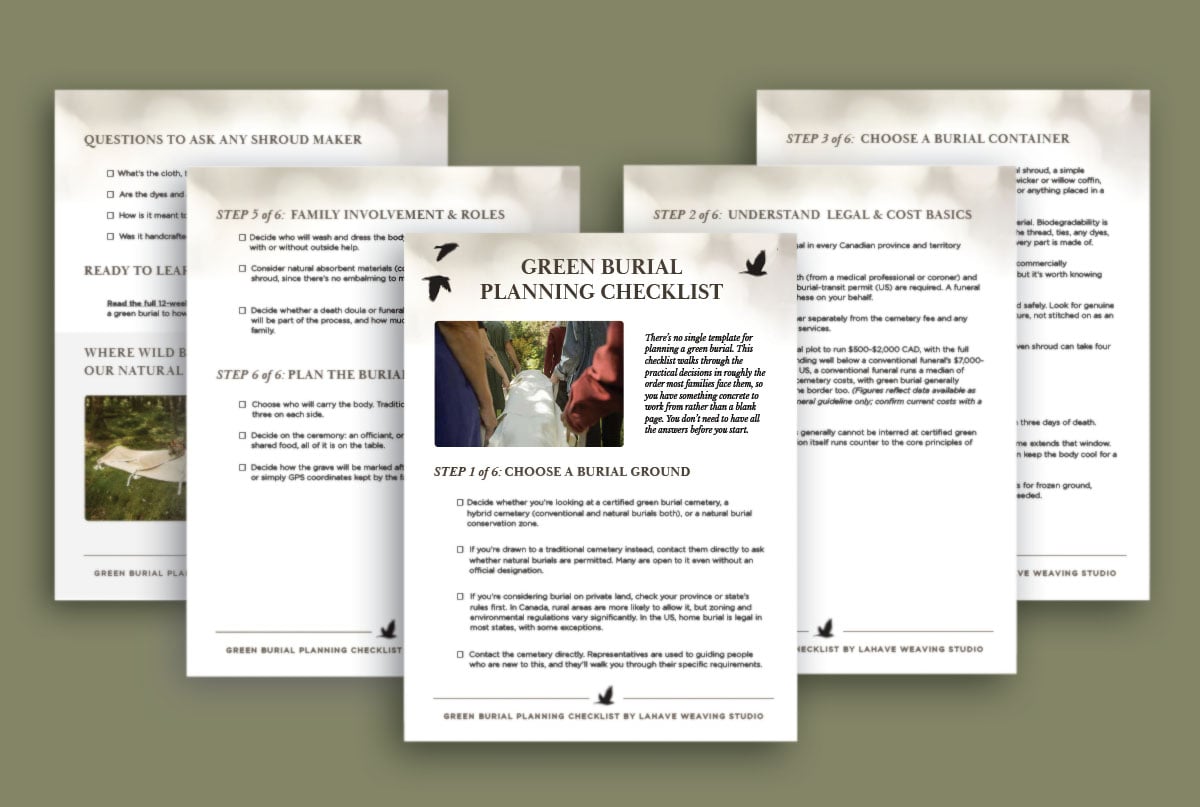
Download Your Free Copy of A Green Burial Planning Checklist
Why Each Shroud Takes So Much Time to Make
Nothing about making a woven burial shroud is fast, and it was never meant to be. When Lesley finally holds the finished bolt of cloth in her arms and feels its weight, she's already thinking of the person it's for. "This will be a beautiful thing for somebody to have." A handwoven shroud costs what it does because it's made of good fibre, designed with care by two people who spent months getting it right, woven on a loom with a history of its own, and finished by hand by a weaver of fifty years. For the families who choose a shroud, that isn't an expense to explain away. It's the reason.
Our shrouds are woven here in Nova Scotia and sent to families across Canada and the United States.
If you are weighing these choices for yourself or someone you love, our green burial FAQ answers the questions most families have about legality, cost, and planning. And when the time comes to choose a shroud, you'll find us at the loom.
Continue the series: From Shroud to Soil: How Natural Fibres Return to Earth
New to the series? Start with What Is Green Burial?
Sources
- Weaving process and shroud construction: interview with Lesley Armstrong, LaHave Weaving Studio (first-hand)
- Shroud fibres, weaves, and design: LaHave Weaving Studio, Natural Burial Shrouds lookbook (first-hand)
Hello, you have a beautiful website. What are the dimensions of the shroud? How do you calculate size? Thank you. Canyon in New Mexico
Leave a comment