

Fifty Years at the Loom: Meet Master Weaver Lesley Armstrong
This is part eleven of our 12-week series on natural burial. New here? Start with our Intro to Green Burial, or check out our previous post, From Shroud to Soil: How Natural Fibres Return to Earth.

A young Lesley Armstrong weaving at Sherbrooke Village, Nova Scotia
Every shroud made at LaHave Weaving Studio passes through the same pair of hands and those hands have been weaving for fifty years. We've spent this series talking about the cloth, the fibres, and the looms but this post focuses on the maker, the person at the loom, Lesley Armstrong. To fully appreciate why a shroud woven by Lesley looks the way it does it helps to know the artist's life that's woven into it.
What you'll learn in this post (11 min read)
It Started With a Warp and a Wooden Loom

The warp and the wooden loom
Lesley didn't grow up with art at school. In rural Nova Scotia schools in the 1960s art class meant colouring in a mimeographed (photocopied) tulip, if that. "It never crossed my mind that art could be a career for me," she says. Lesley went to Acadia University for a year, studied French and hitchhiked around Europe for another year, worked on a sheep farm, and then enrolled in the Nova Scotia College of Art. She started in the Foundation program and one of the next courses she enrolled in was woodworking which she loved.
However, Lesley walked by the weaving studio every day where a pub now sits. It was a large room with plate glass windows filled with wooden looms. Her first teacher was Sandra Brownlee, a well-known textile artist, and that was all it took: Sandra's inspiration and a bunch of yarn. "The moment I started weaving, I was just totally hooked," Lesley remembers. "One hundred percent." That was more than fifty years ago and she knew almost at once that this was what she would do.
The moment I started weaving I was just totally hooked. One hundred percent.
What hooked her, she thinks, was that weaving is never just one thing. "It's step after step after step," she says, "and I enjoyed every step. I still do." Lesley loved starting with the yarn, then the warp, the threading of hundreds of yarns, the lengthwise threads held under tension on the loom that the rest of the cloth gets woven through, and building the tiniest yarns into something tactile and dimensional, whether it became an art piece, a garment, or a length of cloth. That immediate, hands-on sensation never wore off.
She Went Looking for the Whole Craft
At the time the Nova Scotia College of Art and Design (NSCAD) was known for conceptual art, performances and installations, something happening almost every day. Lesley found it fascinating but she also wanted something that the college wasn't able to give her at the time, a deep technical knowledge of weaving itself: how many threads to the inch, how each fibre behaves, and why cloth does what it does. When she asked a visiting conceptual artist about technique he told her that she was "neurotic." So she went looking elsewhere.
Lesley travelled first to Scotland the country her ancestors came from. Before she left she wrote to the Scottish Craft Council and the Highlands and Islands Development Board and asked for the names of every weaver in their associations. Lesley then wrote to all of them, thirty or forty letters, asking if she could visit or stay a day or two, doing whatever work they needed. Almost everyone wrote back. "Those were the times," she says. "Everyone was very, very kind."
Lesley spent the better part of a year apprenticing in weaving. She apprenticed for three months with a weaver named David Gurney in Aberdeenshire and was on a rigorous timetable: the day began with milking the goats, weaving started sharp at nine and ran to six, and after goat milking and supper, David taught double-entry bookkeeping in the evenings. Then Lesley kept going, hitchhiking through the west of Scotland and out to the islands, Skye, the Hebrides, Colonsay, staying with weaver after weaver, winding bobbins, braiding rug fringes, and weaving colourful lengths of wool fabric to be cut into garments in exchange for whatever they could teach her.

The Aberdeenshire coast, Scotland
Most of those visits stayed with her for life. On the Isle of Skye one young weaver and his wife had almost nothing. Charlie wove in a dim cement-block weaving shed with a single window and no electricity. His wife and baby lived with him in a tiny trailer, yet they invited her to lunch and halved their potatoes and their small piece of meat so she could share a meal with them. On another island she walked miles to reach a weaving cooperative and found one lone man in his eighties, the last weaver left of the Port-na-Skye weavers, a small tweed-making community settled by families from Harris and Lewis, standing beside his bolts of tweed with no one there to buy them. "They were just beautiful, beautiful people," she says.
They were just beautiful, beautiful people.
Then she went the other direction entirely, to the Philadelphia College of Textiles and Science, a school with one foot in the weaving mills and one in the fine arts, where most of her teachers were art-school graduates. "It was this beautiful mesh of art and industry," she says and it was the missing half of her education. She went on to a Master's at the Philadelphia College of Art studying fibre art with well-known artist Warren Seelig. Between the experience in the islands and highlands of Scotland and the formal education in Philadelphia, Lesley came home enabled, as she puts it, to make a fibre do almost anything she asked of it, stand up on its own as sculpture or fall into a perfect drape.
A Life Spent Teaching It Forward
For about thirty years Lesley taught weaving at the Nova Scotia College of Art and Design in Halifax, NS, carrying both halves of what she'd learned, the art and the craft, into the studio for her students. She kept making her own work all the while, both sculptural pieces and commercial commissions. By her own count she has taught hundreds of people to weave. Whatever they go on to do in their lives they have experienced weaving, she says, "and can use that skill, if they choose." It's one way the fifty years keep going.

Passing the craft forward, one lesson at a time
She's clear-eyed, too, about what it has meant to do this as a woman. Weaving has long been treated as women's work, the kind once done for "pin money," and that history still shadows what people expect to pay for it. We don't blink at a plumber's or an electrician's hourly rate, she notes, but skilled handweaving, now done mostly by women, is too often quietly undervalued. It's a quiet injustice she's watched her whole career and one reason she's unapologetic about what good cloth is worth.
How the Shrouds Began
The shrouds began, of all places, with two pieces of art.
The first was a woven body bag, Body Bag Series: the Titanic, 1st Class, made in 2013 from handwoven fabric laid over a stainless-steel table, an ornate piece commenting on who was saved first and who wasn't. It was later shown as part of Titanica, an exhibition at the Mary Black Gallery, Craft Nova Scotia, in 2014 and 2015.


The finished Titanic piece from above, a close-up of the woven cloth, and Lesley weaving it at the loom.
A couple of years later she made a second body bag, this one a quiet protest about the war in Afghanistan. Woven in the old rag-rug tradition, the fabric is strips of girls' and boys' pyjamas carried as the weft, the crosswise threads, through the warp. The piece was shown with a looping video of an automatic rifle in a helicopter over the Afghanistan desert, projected onto the body bag, and an accelerating heartbeat playing through a headset. It represented the sadness and futility of war, the pyjamas standing in for the hopes and dreams of young soldiers that so often ended in disillusionment and loss.


Top: The Afghanistan body bag, shown with the projected video loop. Bottom: A closeup detail of the body bag. Photos by Eliot Wright.
And then, almost offhandedly, Lesley said to her husband that she could just be buried in one of these and save everyone a lot of money. The moment she said it, something clicked. But she quickly realized those art pieces could never go in the ground because she had woven with commercially-dyed yarn and sewn in a big industrial zipper and none of that would decompose easily, if at all. So, Lesley started over, asking a different question. What would it take to make a real shroud for a real natural burial?
That's when she brought in her friend Kate Delmage, an apparel designer and artist, to help turn the idea into something real. The full story of that partnership lives in The Art of Weaving a Burial Shroud. Finally, Lesley wove the very first burial shroud, ten or twelve yards of wool on the hand loom, trimmed in matching wool, and handed it to Kate. From there, the Where Wild Birds Sing natural burial shroud collection was born, growing fibre by fibre, detail by detail: the handles, the reinforced base, the sleeve for the plank, all of it. Once there were four finished shrouds, photographer Chris Geworsky captured the shroud collection in the woods along Nova Scotia's South Shore. Then Lesley's studio hosted a well-attended collection launch at Lesley's daughter's house. What had started as an offhand remark to her husband had truly become something real.
Why Cloth, and Why Shrouds?
Ask Lesley why cloth and her answer is disarmingly simple. "I love beautiful cloth," she says, and she always has, whether it's a rough artisanal weave or the finest silk. But there's something deeper underneath it, too.
"You're born and they don't put you in a little wooden box," she says. "You're basically wrapped in cloth immediately, for warmth and comfort." We come into the world swaddled; cloth is the first thing to hold us, our second skin, the thing that keeps us warm and dry and comforted all our lives. To Lesley it's the most natural thing to leave the world in as well. "That's what I would want to be wrapped in. Cloth, not wood." And because the fibres are natural they don't just decompose, they give back; linen returns to the soil it grew from and wool feeds the earth the way gardeners now use it to feed their beds. The whole arc closes on itself. A nice return, she calls it.
Lesley's work recently caught the attention of CBC News, which visited her studio to see the process firsthand. Read the full feature here.
It's no accident that alongside the shrouds, Lesley also weaves baby blankets, the very opposite end of life. Cloth holds us coming into the world and cloth can hold us leaving it, and she likes weaving for both ends of that arc. In fact, she has the warp ready to weave another run of blankets this summer.
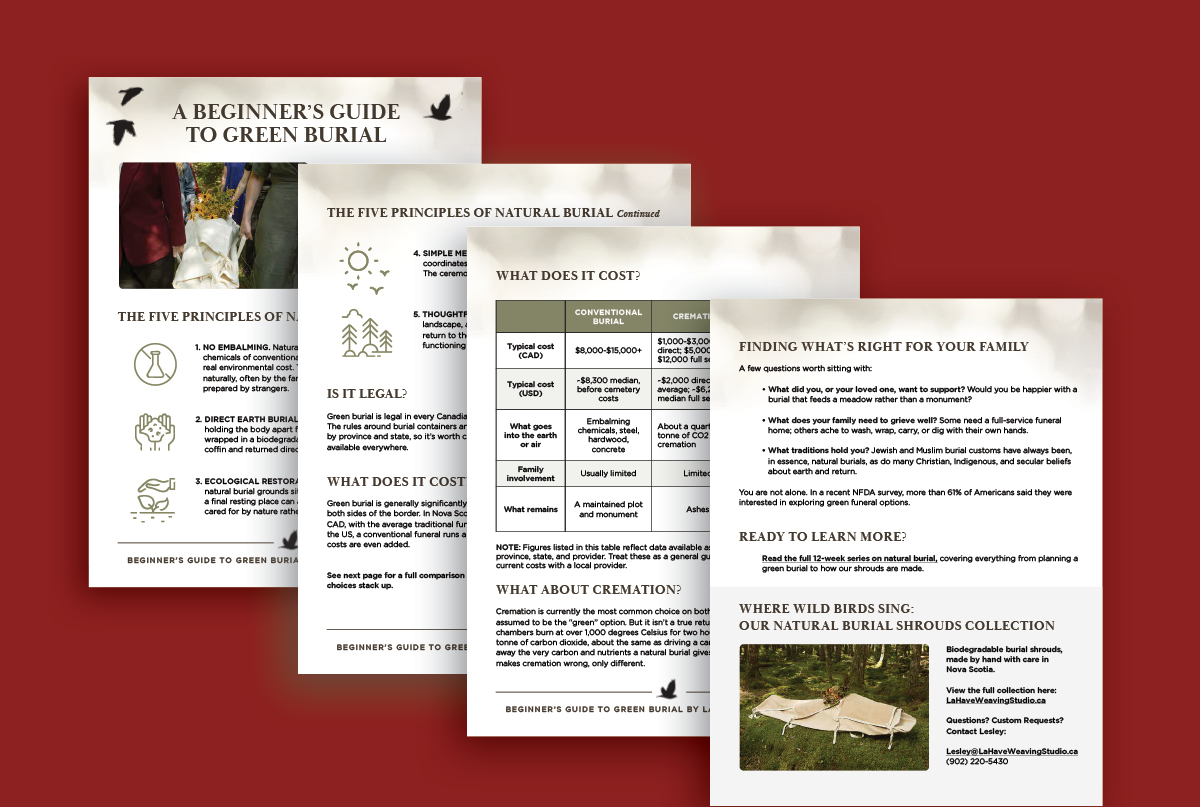
Download Your Free Copy of A Beginner's Guide to Green Burial
What Her Work Means to Her Now
Lesley has made art her whole life and she'll tell you it always had meaning. But this work sits closer to the heart. "It's an interesting kind of legacy," she says, "because the legacy is that it returns back to the earth again." No monument, no name carved over a door. Just a quiet giving-back.
Some people have asked her what it could possibly matter at the end when you're gone and won't know the difference. She doesn't argue but she doesn't agree either. We dress with care for every important occasion of a life, she points out, and this is the last one. "It's your choice to have that. Why not be encompassed in something beautiful in the end? And just as important, a natural burial is an act of respect for the earth: contributing to its wellbeing instead of harming it with chemicals, giving back nutrients with our body and with our shroud." To know that someone has chosen one of her shrouds for their final rest and that she and Kate have made it as beautiful and as dignified as they possibly can, she finds genuinely moving. "It's pretty meaningful for me, to do that."
Why not be encompassed in something beautiful in the end?

Checking the cloth against the reed, the comb-like frame that beats the weft into place
Rooted on the South Shore
It's hard to imagine this work happening anywhere but here. Lesley was born just across the river from the studio where she still weaves today, in Lunenburg County, Nova Scotia, where the ocean and the LaHave River shape the landscape and where neighbours of every age have small businesses like growing vegetables or raising sheep and chickens, foraging for mushrooms, or sometimes working with digital technology from home. "It's kind of all about nature here," she says. "One can't help but be influenced by the river, the ocean, the landscape." She doesn't think the shrouds would have come into being if she still called the city home; this work seems to want the beauty and the closeness to the land that the South Shore gives it.

A view toward the harbour, Lunenburg, Nova Scotia
She has one more quiet hope, too. She would love to see a natural burial ground right here in Lunenburg County: a piece of wild landscape left to flourish and gently enhanced, native plants taking root, native stone marking the way, and somewhere local families could choose to return to the earth in the place they love. She imagines every county having one. "The icing on the cake," she calls it. It may or may not happen in her lifetime, she admits, but it's a beautiful thing to think about. Knowing Lesley, fifty years in and still dreaming the next thing into being, it's exactly the kind of idea she'd find a way to make real.
Our shrouds are woven here in Nova Scotia and sent to families across Canada and the United States.
If you'd like to understand the choice more fully, our green burial FAQ answers the questions most families have about legality, cost, and planning. And when the time comes to choose a shroud, you'll find us at the loom.
Continue the series: A Death Doula's Take on Natural Burial Shrouds
New to the series? Start with What Is Green Burial?
Sources
- Lesley Armstrong's training, career, and the origin of the shroud collection: interview with Lesley Armstrong, LaHave Weaving Studio (first-hand)
- Green burial context and Lesley's studio: Moira Donovan, "Meet the Nova Scotian weaving together a more sustainable burial," CBC News
Leave a comment